
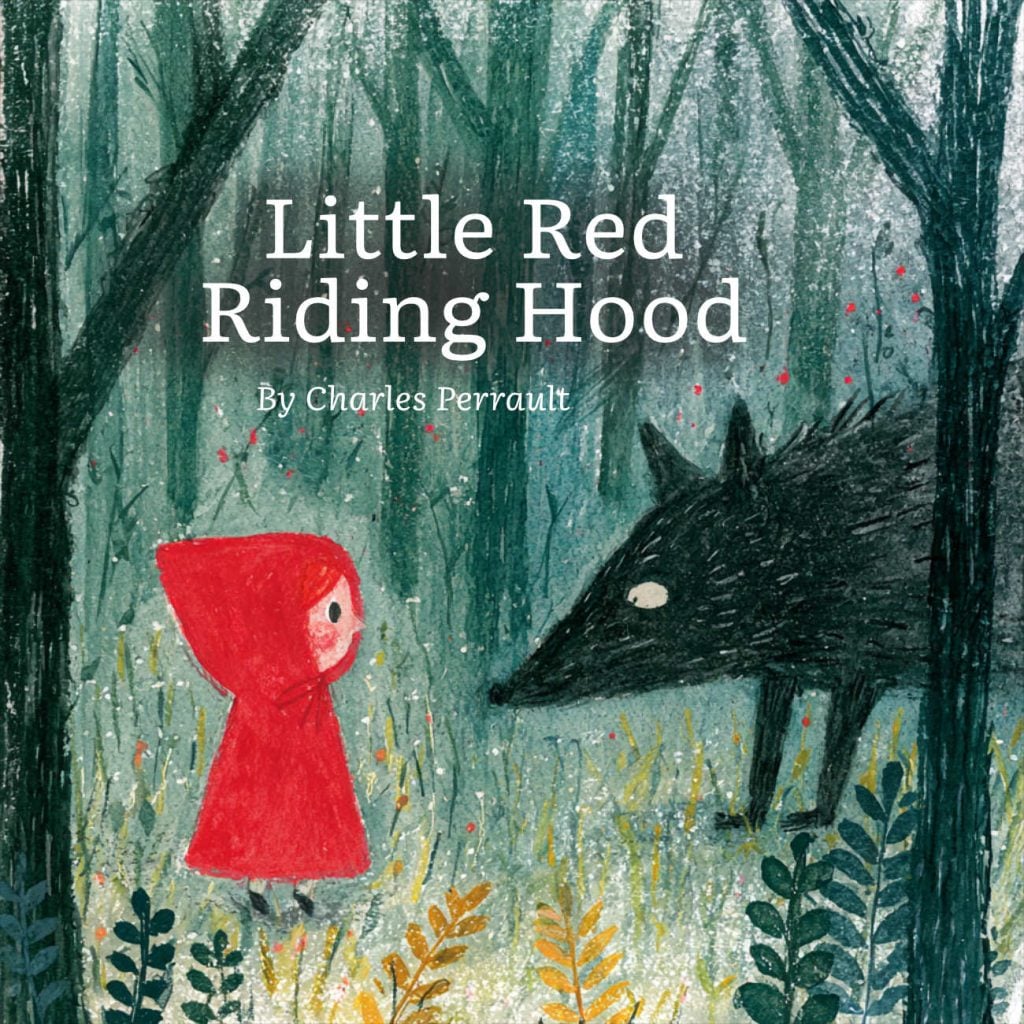
Little Red Riding Hood
Little Red Riding Hood sets off through the forest with food for her sick grandmother, but a seemingly friendly wolf learns where she is going and races ahead. When the wolf disguises himself in Grandmother’s bed, Little Red Riding Hood must recognise the danger before it is too late.
If you prefer a gentler retelling, read the Storyberries Feel-Good Fairy Tale version of Little Red Riding Hood.
Listen to the audiobook
Read ‘Little Red Riding Hood’ online for free
Once upon a time there lived on the borders of a great forest a woodman and his wife who had one little daughter, a sweet, kind child, whom every one loved. She was the joy of her mother’s heart, and to please her, the good woman made her a little scarlet cloak and hood, and the child looked so pretty in it that everybody called her Little Red Riding Hood.

One day her mother told her she meant to send her to her grandmother—a very old woman who lived in the heart of the wood—to take her some fresh butter and new-laid eggs and a nice cake. Little Red Riding Hood was very pleased to be sent on this errand, for she liked to do kind things, and it was so very long since she had seen her grandmother that she had almost forgotten what the dame looked like.

The sun was shining brightly, but it was not too warm under the shade of the old trees, and Red Riding Hood sang with glee as she gathered a great bunch of wild flowers to give to her grandmother. She sang so sweetly that a cushat dove flew down from a tree and followed her.
Now, it happened that a wolf, a very cruel, greedy creature, heard her song also, and longed to eat her for his breakfast, but he knew Hugh, the woodman, was at work very near, with his great dog, and he feared they might hear Red Riding Hood cry out, if he frightened her, and then they would kill him. So he came up to her very gently and said:
“Good day, Little Red Riding Hood; where are you going?”
“To see my grandmother,” said the child, “and take her a present from mother of eggs and butter and cake.”
“Where does your grandmamma live?” asked the wolf.
“Quite in the middle of the wood,” she replied.
“Oh! I think I know the house. Good day, Red Riding Hood.” And the wolf ran off as fast as he could.

Little Red Riding Hood was not in a hurry, and there were many things to amuse her in the wood. She ran after the white and yellow butterflies that danced before her, and sometimes she caught one, but she always let it go again, for she never liked to hurt any creature.

And then there were the merry, cunning little squirrels to watch, cracking nuts on the branches of the old trees, and every now and then a rabbit would hurry away through the tall ferns, or a great bee come buzzing near her, and she would stop to watch it gathering honey from the flowers, and wild thyme. So she went on very slowly.
By-and-by she saw Hugh, the woodman.
“Where are you going, Little Red Riding Hood,” said he, “all alone?”
“I am going to my grandmamma’s,” said the child. “Good day; I must make haste now, for it grows late.”
While Little Red Riding Hood was at play in the wood, the great wolf galloped on as fast as he could to the old woman’s house. Grandmother lived all by herself, but once or twice a-day a neighbour’s child came to tidy her house and get her food.
Now, grandmother was very feeble, and often kept her bed; and it happened that she was in bed the day Little Red Riding Hood went to see her. When the wolf reached the cottage door he tapped.
“Who is there?” asked the old dame.

“Little Red Riding Hood, granny,” said the wolf, trying to speak like the child.
“Come in, my dear,” said the old lady, who was a little deaf. “Pull the string and the latch will come up.”
The wolf did as she told him, went in, and you may think how frightened poor grandmother was when she saw him standing by her bed instead of Little Red Riding Hood.
Very soon the wolf, who was quite hungry after his run, ate up poor grandmother.
Indeed, she was not enough for his breakfast, and so he thought he would like to eat sweet Red Riding Hood also. Therefore he dressed himself in granny’s nightcap and got into bed, and waited for the child to knock at the door. But he waited a long time.
By and by Little Red Riding Hood reached her grandmother’s house, and tapped at the door.

“Come in,” said the wolf, in a squeaking voice. “Pull the string, and the latch will come up.”
Red Riding Hood thought grandmother must have a cold, she spoke so hoarsely; but she went in at once, and there lay her granny, as she thought, in bed.
“If you please, grandmamma, mother sends you some butter and eggs,” she said.
“Come here, dear,” said the wicked wolf, “and let me kiss you,” and Red Riding Hood obeyed.

But when Red Riding Hood saw the wolf she felt frightened. She had nearly forgotten grandmother, but she did not think she had been so ugly.
“Grandmamma,” she said, “what a great nose you have.”
“All the better to smell with, my dear,” said the wolf.
“And, grandmamma, what large ears you have.”
“All the better to hear with, my dear.”
“Ah! grandmamma, and what large eyes you have.”
“All the better to see with, my dear,” said the wolf, showing his teeth, for he longed to eat the child up.
“Oh, grandmamma, and what great teeth you have!” said Red Riding Hood.
“All the better to eat you up with,” growled the wolf, and, jumping out of bed, he rushed at Red Riding Hood and would have eaten her up, but just at that minute the door flew open and a great dog tore him down. The wolf and the dog were still fighting when Hugh, the woodman, came in and killed the wicked wolf with his axe.

Little Red Riding Hood threw her arms round the woodman Hugh’s neck and kissed him, and thanked him again and again.
“Oh, you good, kind Hugh,” she said, “how did you know the wolf was here, in time to save me?”
“Well,” said Hugh, “when you were gone by, I remembered that a wolf had been seen about the wood lately, and I thought I would just come after you and see if you were safe. When we came near grandmother’s house my dog Trim sniffed and ran to the door and whined, and then he pushed it open—you had not shut it close—and rushed in, and I followed him, and between us we have killed the wolf.”
Then Hugh took the child home, and her mother and father could not thank him enough for saving Little Red Riding Hood.
Fairy Tale adapted from Charles Perrault
Let’s talk about ‘Little Red Riding Hood’!
Spark a conversation with your child and connect the story to real-life lessons.
Stranger Danger
- Little Red Riding Hood tells the wolf exactly where she is going. What information could she have kept private while still being polite?
- The wolf speaks gently when he first meets her. Why is someone’s friendliness or appearance not enough to tell us whether a situation is safe?
- If someone you did not know asked where you lived or where you were going, what could you do or who could you ask for help?
Thinking Ahead
- What clues could Little Red Riding Hood have noticed before entering Grandmother’s house?
- How does the wolf use the information Little Red Riding Hood gives him to plan what he will do next?
- If Little Red Riding Hood could begin her journey again, what choices might help her reach Grandmother’s house more safely?
Family
- Why do Little Red Riding Hood and her mother prepare food for Grandmother?
- What does the errand tell us about the relationship between Little Red Riding Hood and her grandmother?
- What are some ways family members can look after one another when someone is sick or needs extra help?
Helping
- Hugh decides to follow Little Red Riding Hood because he remembers that a wolf has been seen nearby. What makes his decision helpful?
- How does Hugh’s dog Trim help him realise that something is wrong at Grandmother’s cottage?
- What does the story suggest about paying attention when another person might need help?
Vocabulary
- Woodman
- A person whose work involves cutting or caring for trees and wood.
- Errand
- A short journey made to deliver something or complete a particular task.
- Scarlet
- A bright shade of red.
- Dame
- An old-fashioned word for a woman, especially an older woman.
- Cushat
- An old name for a wood pigeon.
- Glee
- A feeling of great happiness or excitement.
- Feeble
- Weak or lacking physical strength.
- Latch
- A simple fastening used to keep a door or gate closed.
Context
Little Red Riding Hood is a traditional fairy tale in the international ATU 333 story family, and this is an adaptation of Charles Perrault’s version. Its best-known features include the red hood, the forest journey, the deceptive wolf, the visit to Grandmother and the repeated “what big eyes/ears/teeth you have” dialogue. This version changes the ending by having Hugh the woodman and his dog Trim rescue Little Red Riding Hood, while Perrault’s earlier published tale ends without a rescue.
The story’s repetition and recognizable dialogue support prediction, sequencing and oral-language skills, while its different historical versions provide useful opportunities for comparing adaptations. Its safety theme is most useful when discussed in terms of protecting personal information, noticing behavior and seeking help from trusted adults rather than trying to judge whether someone is safe from their appearance. Children can use the story to explore how thinking ahead and asking for help can support safer decisions.
FAQs about ‘Little Red Riding Hood’
What is Little Red Riding Hood about?
Little Red Riding Hood follows a young girl carrying food through the forest to her sick grandmother. Along the way, she tells a wolf where she is going, allowing him to reach Grandmother’s cottage first. The wolf disguises himself as Grandmother and tries to attack Little Red Riding Hood. In this version, Hugh the woodman and his dog Trim arrive in time to save her.
Who wrote Little Red Riding Hood?
Little Red Riding Hood is an old European fairy tale with many versions rather than a story created by a single modern author. This Storyberries text is specifically credited as a fairy tale adapted from Charles Perrault, whose famous French version, Le Petit Chaperon rouge, was published in 1697. Perrault’s version helped establish many of the elements readers now associate with the tale. This adaptation changes some important plot details, particularly the ending.
How is this version different from Charles Perrault’s original Little Red Riding Hood?
In Perrault’s published version, the wolf eats Grandmother and then Little Red Riding Hood, and nobody arrives to rescue them. Perrault ends the story with a direct warning about deceptive “wolves” who may appear polite or charming. In this adaptation, the wolf still eats Grandmother, but Hugh the woodman and his dog Trim arrive before Little Red Riding Hood is eaten. This gives the adaptation a rescue ending while retaining much of the familiar Perrault storyline.
How is Little Red Riding Hood different from the Brothers Grimm version?
Compare with the English story at Storyberries: The True Story of Little Golden Hood, which plays off the original, and sees both Grandma and the little heroine escape being eaten. Although this current version has Hugh and Trim arrive before the wolf can eat Little Red Riding Hood, Grandmother is not restored. Comparing the versions shows how the same traditional tale can change as it is retold.
Why does the wolf ask Little Red Riding Hood where she is going?
The wolf wants information that will help him reach Grandmother’s cottage before Little Red Riding Hood. Because she trusts him, she tells him that Grandmother lives in the middle of the wood. He then runs ahead while she spends time looking at flowers and animals. This part of the story provides a useful starting point for discussing stranger danger and keeping private information private.
What happens to Grandmother in this version?
The wolf reaches the cottage before Little Red Riding Hood and tricks Grandmother into opening the door. He then eats her and puts on her nightcap before climbing into her bed. Unlike the Brothers Grimm version, the Storyberries text does not later restore Grandmother.
How is Little Red Riding Hood saved?
When Hugh sees Little Red Riding Hood in the forest, he remembers that a wolf has recently been seen nearby and decides to follow her. Near Grandmother’s cottage, his dog Trim becomes suspicious, runs to the door and pushes it open. Trim attacks the wolf, and Hugh then kills it with his axe before it can eat Little Red Riding Hood. Their actions provide a useful example for discussing helping when someone may be in danger.
What are the main themes of Little Red Riding Hood?
The story explores trust, deception, personal safety, family care and thinking ahead. The wolf succeeds because he appears friendly while secretly planning harm, making the difference between appearance and behavior especially important. Little Red Riding Hood’s journey also shows how sharing information without considering its consequences can change what happens next. These themes make the story useful for discussing thinking ahead without suggesting that children should be afraid of everyone they do not know.
How can parents talk about stranger safety using Little Red Riding Hood?
Rather than teaching children that every unfamiliar person is dangerous, parents can focus on practical safety rules. Children can learn that private information such as their address, destination or daily routine should not be shared simply because someone asks for it. They can also identify trusted adults they can approach if a situation makes them uncomfortable or confusing. The story offers a useful opportunity to distinguish between someone’s friendly appearance and whether their behavior respects safe boundaries.
How can teachers use Little Red Riding Hood in class?
The repeated dialogue between Little Red Riding Hood and the disguised wolf makes the story useful for prediction, dramatic reading and oral-language activities. Students can sequence the journey from home to the forest and then to Grandmother’s cottage, identifying which decisions affect later events. Older children can compare this adaptation with Perrault’s and the Brothers Grimm’s versions. That comparison supports critical thinking about how fairy tales change to suit different audiences and periods.
What is the Aarne–Thompson–Uther classification of Little Red Riding Hood?
Little Red Riding Hood belongs to ATU 333, “Little Red Riding Hood.” The Aarne–Thompson–Uther system groups traditional stories according to shared plot structures and motifs. D. L. Ashliman’s University of Pittsburgh ATU 333 collection includes Perrault’s Little Red Riding Hood, the Brothers Grimm’s Little Red Cap and related versions from several countries. This makes the tale a particularly useful example of how one story pattern can develop into many distinct retellings.
Is there a gentler Storyberries version of Little Red Riding Hood?
Yes. Storyberries also has a modern Feel-Good Fairy Tale version of Little Red Riding Hood. That retelling offers families another way to enjoy the familiar characters without using the darker events of this vintage tale. The classic version here is placed in Storyberries’ Age 7–12 and 10 Min Stories collections.
Credits
- Fairy tale adapted from: Charles Perrault
- Audiobook read by: Jade Maitre