
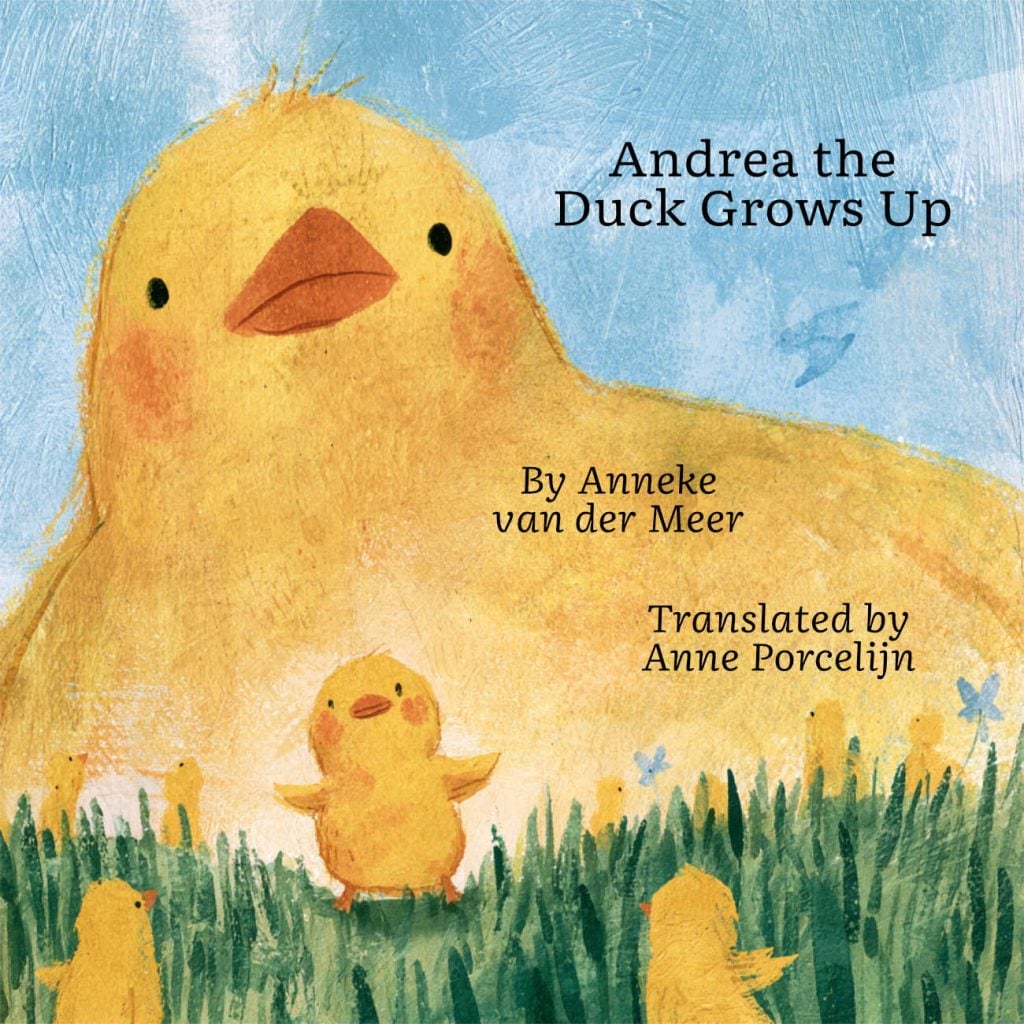
Andrea Duck had just climbed ashore. Because the sun was so warm, she decided to have a quick nap. She carefully balanced on one leg and tucked her head under her wings. Just before she fell asleep, she remembered the time when she was still a tiny, yellow ball of fluff. Andrea the Duckling!
Suddenly she saw herself as a tiny duckling in the water. Swimming in the big, beautiful world of wind and sun. But she also noticed the dark reeds she had to swim through as a duckling. And where she knew there were rats waiting for little ducklings like her. They could suddenly pull you down into the water by your legs, and…

Andrea remembered how, as a young duck, she couldn’t control all her muscles like other little ducklings could. She had not yet learned how to use her webbed feet properly. And that became painfully obvious one terrible day. Right at the moment when she wanted to show mother duck how clever and independent she already was. That was a really awful day!
But she found something! In order to prove herself different, and not just a tiny duckling who was sometimes really scared by the big watery world, she had invented something. Something she had discovered quite by accident.
She had discovered that she only had to peep ‘Fletch’ or ‘Flatch’ instead of quacking like a normal duckling. If she peeped ‘Fletch’ or ‘Flatch’, all the other young ducks put their heads together and started to quack,
“Have you heard? Andrea said ‘Fletch’ and even ‘Flatch’!”
To Andrea’s astonishment, every time she peeped ‘Fletch’ or ‘Flatch’, all the other ducks quacked about it. So then she made up ‘Flotch’ and ‘Flutch’ and that had even more success. It wasn’t until later that she understood that, in duck language, these were naughty words.
Andrea the duck was almost asleep in the warm sun, with her head under her wings, but she had to grin at the memory of all this. It was actually very clever of the little duckling Andrea. And when she had grown up and become a young duck who could manage her webbed feet perfectly, she had found other ways of expressing herself. Saying ‘Fletch’, ‘Flatch’, ‘Flotch’ and ‘Flutch’ got lots of reactions, but not exactly the reaction she wanted.
What did she really want? Was it to make lots of noise with the other young ducks, and to pinch their strong little bodies with her beak? Was it to throw mud at them with her webbed feet? Or was it just to chat with them? To tell the others clearly what she felt and thought?
If the slightly older drakes were teasing her, she wanted to learn to shake off their words, in the same way that a duck shakes off drops of water from its feathers. She’d had to learn to do that – shake off all the drops of water – but imagine being able to do that with the drakes’ teasing! Just to shake it all off! That would surprise them! That was a much better way of getting to them than pinching them with her beak. Andrea thought back and was very satisfied with her behavior as a young duck – she wasn’t stupid! Not at all!
Andrea knew that she could now express herself really clearly, and she wondered how and when she learned this, that clear quacking she could now do. She couldn’t remember; it must have happened of its own accord. She no longer found it interesting to use ‘Fletch’, ‘Flatch’, ‘Flotch’ and ‘Flutch’. Whichever way you looked at it, they were not clear quacking in duck language.
By now Andrea was fast asleep with her head under her wings, in the big outdoor world where the reeds rustled gently and the birds sang tirelessly. The sun shone warm on Andrea’s head, and the rays were mirrored in the rippling of the water.
If you see Andrea there in the grass, standing strongly on one leg, then you can be so pleased to see that she has grown beautifully! And you can understand at once how she discovers more of the world each and every day, learning to express herself better, with more and more self-confidence, without needing to use naughty duck words.

Bedtime Story for Kids by Anneke Van Der Meer
Translated by Anne Porcelijn, Edited by Jade Maitre
LET’S DISCUSS THE STORIES ~ IDEAS FOR TALKING WITH KIDS
Communication
1. Why do you think we use words to communicate with one another?
2. Do you ever know how someone else is thinking, without using words? How can you tell?
3. What other kinds of ways can we communicate with each other without using words?