
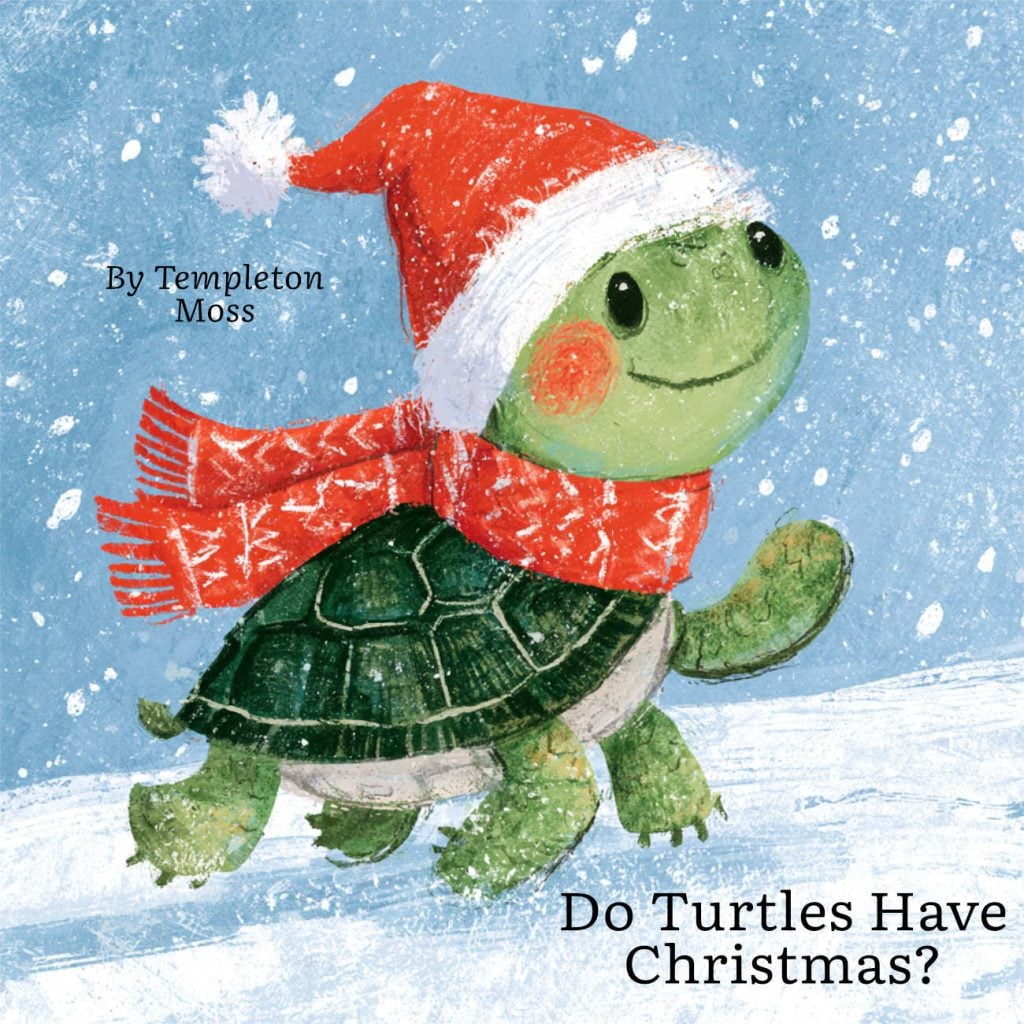
Do Turtles Have Christmas?
Greg the pet turtle watches Molly’s family decorate their home for Christmas and wonders whether Santa brings presents to animals, too. As Christmas Eve arrives, Greg fears he will be forgotten. This gentle, funny Christmas story for kids explores kindness, inclusion and the joy of finding a gift that truly suits someone.
Read
Read the story at your own pace.
Greg got up that morning the same as always. He looked around his room with its tall, clear walls and went to get a drink from his dish. As he shook off the last bits of sleep he looked out his walls to see what the people were doing. They were putting decorations all over the house. Big red and green things that Greg didn’t understand. In particular, a lot of them seemed to show a big fat guy in red pajamas and a white beard. Molly was asking her big sister, Mabel, a lot of questions.
“Is he really gonna come tomorrow night?”
“Of course he is. You wrote him a letter, didn’t you?”
“Yes, but are you sure he read it?”
“I told you, Molly. Santa visits everyone who writes him a letter.”
“But how does he do it all in one night?”
“Magic, of course. I don’t know exactly how it works, but I think he can freeze time or something.”
“Wow!”
There were a lot of words that Greg had never heard before. Santa. Christmas. Rudolph. Some King or other called Nat. It was all very confusing to Greg. Luckily, later that day, Molly reached into Greg’s room and picked him up to show him something.
“Look how beautiful our tree is, Greg.”
Greg looked and saw a large evergreen tree inside the house covered in colored lights and other ornaments. He had to admit it was beautiful but he didn’t exactly know what it was for.
“And tomorrow night, Santa’s going to come and leave us presents for Christmas. And I asked him to bring something for you, too. Even though I don’t know what turtles want for Christmas. Well, I’d better put you back. I have to go help Mommy in the kitchen.”
It was a very confused turtle whom Molly returned to his room a moment later. Christmas? What’s Christmas? And who is this Santa who’s supposed to bring me something? It was very overwhelming. But that night, many of his questions were answered. His room happened to be in such a place that it faced the TV so when the girls watched a movie called “A Christmas Carol” he learned a lot about this Christmas business.
Evidently, Greg concluded, it’s a holiday that happens in the winter where everyone gets together and eats and drinks and has lots of fun and gives each other presents. It sounded nice, but it still left Greg with one burning question:
Do turtles have Christmas?
The holiday, it seemed, had something to do with a little baby called…something with a “J”, he couldn’t remember. But the impression that Greg got was that this “Christmas” was this baby’s birthday. Did you have to know the baby to celebrate? Are turtles allowed to celebrate? It seemed to have a lot to do with presents. Was it still Christmas if you didn’t get a present? Or give one?
Greg spent much of the night pondering these questions and the next day (which Molly said was called “Christmas Eve”), the girls watched some more movies and shows which told Greg a little more about the holiday. This Santa fellow lives at the North Pole and on Christmas Eve (that’s tonight! he thought with some excitement) he flies in a magic sleigh pulled by eight flying reindeer and delivers gifts to all the good little boys and girls and…
His heart sank. Boys and girls. Not turtles. He was a boy turtle, sure, but he had the clear impression that this is not what they meant. Oh well, he thought, as he watched another show about a snowman with a special hat. No Christmas for me.
That night, Greg was awakened by a strange sound. A sort of “THUD” as if something had landed on the roof. Greg was frightened. If it was burglars, he was ill-equipped to do anything about it except hope and pray that turtles were not valuable on the black market. But then he heard another sound: Bells! Very small bells! He remembered from his TV research that Santa’s sleigh had bells on and often landed on rooftops. Am I going to get to see Santa Claus?
He did! Santa came down the chimney and set about his work. Putting packages under the tree, eating milk and cookies, filling the stockings. Greg watched him, transfixed. The bright smile, the red suit, the white beard. He’s just the way I thought he’d be, said Greg to himself. I may not get any presents, but it’s enough to get to see him!
And then, just as Santa was about to leave, he turned his head in the direction of Greg’s room. He looked at the turtle and smiled.
“Well, hello there, Greg!” he said as he walked over to him. “You don’t remember me, do you? Well, you wouldn’t, I guess. You were so very small when I brought you here. You see, you were Molly’s Christmas present last year. And she asked me to make sure you got a present this year. Don’t look so surprised,” said Santa, kindly at Greg’s reaction. “Didn’t you know? Christmas is for everyone. And you’ll get a present, too…but only if you go right to sleep! Now, now, rules are rules. If you want your present, you’ll just have to wait till morning.”
Greg shut his eyes obediently and tried to fall asleep.
“That’s better. Now don’t open them till tomorrow. And Merry Christmas, Greg.”
He heard Santa place something inside his room and creep away. In another moment he heard the sleighbells, the muffled cry of Santa and then…nothing. Santa was gone. It was tempting, but Greg kept his eyes shut until he fell asleep.
“Merry Christmas!” Greg woke to the joyous cry of Molly and Mabel as they ran downstairs for their presents. Their parents followed, somewhat less enthusiastically, but still all smiles. Greg watched through the walls of his room as the girls opened their presents and showed them off for their parents. It was a wonderful scene and Greg was very happy to have seen it.
“Look,” said Molly, suddenly. “Santa left something for Greg, too.” Greg had almost forgotten. With the great effort that it took for him to move at all, Greg turned around and saw…a great big head of lettuce! And it was all for him. As Greg began to munch on the crisp green leaves he thought of what Santa had said to him before he left.
“Merry Christmas, Santa,” he thought. “And thank you for the best Christmas I ever had.”
THE END

Copyright © Storyberries
Explore the story
Context
Explore the ideas, feelings and learning behind the story.
This contemporary Christmas story is told largely through the viewpoint of Greg, a pet turtle living with Molly and her family. The familiar routines of decorating, watching Christmas programmes and expecting Santa seem puzzling because Greg is learning about them for the first time.
Greg hears that Santa brings gifts to good boys and girls and mistakenly concludes that turtles cannot be included. The misunderstanding creates gentle humour and a recognisable feeling of exclusion. His meeting with Santa offers a reassuring change in perspective.
The final head of lettuce turns the idea of a perfect present into a discussion about paying attention to another person’s—or animal’s—needs. Children can practise questioning assumptions, noticing others’ feelings and expressing gratitude for thoughtful gestures.
Vocabulary
Discover useful new words and what they mean.
- Evergreen
- A plant or tree that stays green throughout the year.
- Ornaments
- Decorations used to make something look festive or beautiful.
- Overwhelming
- Feeling like there is too much to think about or deal with.
- Pondering
- Thinking carefully about a question or idea.
- Ill-equipped
- Not having the skills or things needed for a situation.
- Transfixed
- So interested or surprised that you hardly move or look away.
- Obediently
- Doing what someone has asked or told you to do.
- Muffled
- Made quieter or less clear, as though something is blocking the sound.
Discussion questions
Use the story to spark thoughtful, imaginative conversations.
Kindness
- Santa brings Greg lettuce instead of a toy. How can we tell which gift would make someone feel cared for?
- Molly remembers to ask Santa for a present for Greg. What does this show about the way she treats her pet?
- What small thing could you do to make someone feel remembered during a celebration?
Empathy
- How do you think Greg feels when he hears Santa visits boys and girls but not turtles?
- Why might someone feel left out even when the people around them care about them?
- How could Molly have reassured Greg if he had been able to tell her his worries?
Independent Thinking
- Which ideas about Christmas does Greg learn from watching other people, and which does he guess on his own?
- What could Greg have asked to find out whether Santa visits animals?
- Can you think of a time you changed your mind after learning something new?
Gratitude
- What makes Greg call the lettuce his best Christmas present?
- Why do you think Greg thanks Santa even though Santa has already left?
- How can we show thanks for a kind gesture without needing another present in return?
Frequently Asked Questions
Helpful answers for parents and teachers.
What happens in Do Turtles Have Christmas?
Greg, a pet turtle, watches Molly and her family decorate their home, discuss Santa and celebrate Christmas. He learns about the holiday by listening to the children and watching television, but worries that gifts are only for human boys and girls. On Christmas morning, he finds that Santa has remembered him with a surprise chosen especially for a turtle.
Why does Greg think turtles might be left out at Christmas?
Greg hears Christmas explained mainly in terms of presents for “good little boys and girls.” Because he is a turtle, he assumes those words cannot include him, even though Molly clearly cares about him. His misunderstanding gives children a way to discuss what it feels like to be on the outside of a celebration, and why asking questions can be helpful.
How does the story show kindness without making the present expensive?
Molly remembers her pet when she writes to Santa, and Santa chooses something Greg can enjoy: a head of lettuce. The surprise matters because it shows attention to his needs, not because it costs a lot. After reading, you could ask children to think of a thoughtful gift or action for someone they know. Explore more stories about kindness.
Is a big head of lettuce a suitable meal for a real pet turtle?
The lettuce is a playful ending to a fictional story, not a feeding guide. Real turtles need species-appropriate, balanced diets; some eat leafy vegetables, while others need more animal-based food, and a single vegetable should not be assumed to meet all their needs. The RSPCA guide to feeding reptiles explains why turtle diets vary by species and age.
How can this story help children talk about belonging?
Greg’s worry begins when he hears that Santa visits boys and girls and decides that a turtle must not count. Santa’s welcome overturns that assumption. An adult could pause before the ending and ask how Greg might be feeling, then invite children to recall a time they wanted to be included. The empathy stories collection offers further conversation starters.
Does the story say everyone has to celebrate Christmas?
No. The story follows one family’s Christmas traditions and Greg’s wish to be included in their festivities; it does not discuss families who celebrate other holidays or none at all. Santa’s statement that Christmas is for everyone works within this fictional world. When sharing the story, you can acknowledge that families observe different traditions while still exploring its broader themes of care and belonging.
What Christmas traditions appear in Greg’s family home?
The family puts up decorations and a Christmas tree, writes a letter to Santa, watches festive programmes and leaves milk and cookies for him. On Christmas morning, Molly and Mabel open their gifts with their parents. These details provide useful prompts for comparing how different households celebrate. Readers looking for more seasonal fiction can browse Storyberries’ Christmas stories for kids.
Which vocabulary and storytelling techniques can children notice?
The story uses Greg’s limited point of view to make familiar Christmas customs seem strange. Words such as “transfixed,” “pondering” and “obediently” describe attention, thought and behaviour, while the repeated question about whether turtles have Christmas creates anticipation. You could reread the moments when Greg misunderstands what he hears and ask children how the meaning changes once he meets Santa.
How can teachers use this story for a short discussion activity?
After reading, ask pupils to sort Greg’s thoughts into what he knows, what he guesses and what he discovers. His conclusions about Santa offer a clear example of how assumptions can change when new information appears. Children could then draw or describe a carefully chosen gift for a fictional animal, explaining why that animal would like it. This keeps the activity connected to the story.
Who wrote and illustrated Do Turtles Have Christmas?
The published Storyberries credits name Templeton Moss as both writer and illustrator. Keeping both roles together helps readers notice how a creator can tell a story through words and pictures, even when most of this page is prose. If children enjoy Greg’s gentle humour, they can explore the Templeton Moss author archive for other work credited to the same creator.
Credits
Meet the people who brought Do Turtles Have Christmas? to life.
Story written by Templeton Moss.
Story illustration by Templeton Moss.
Support the author: Visit Templeton Moss’s online bookshop.

Copyright © Storyberries