
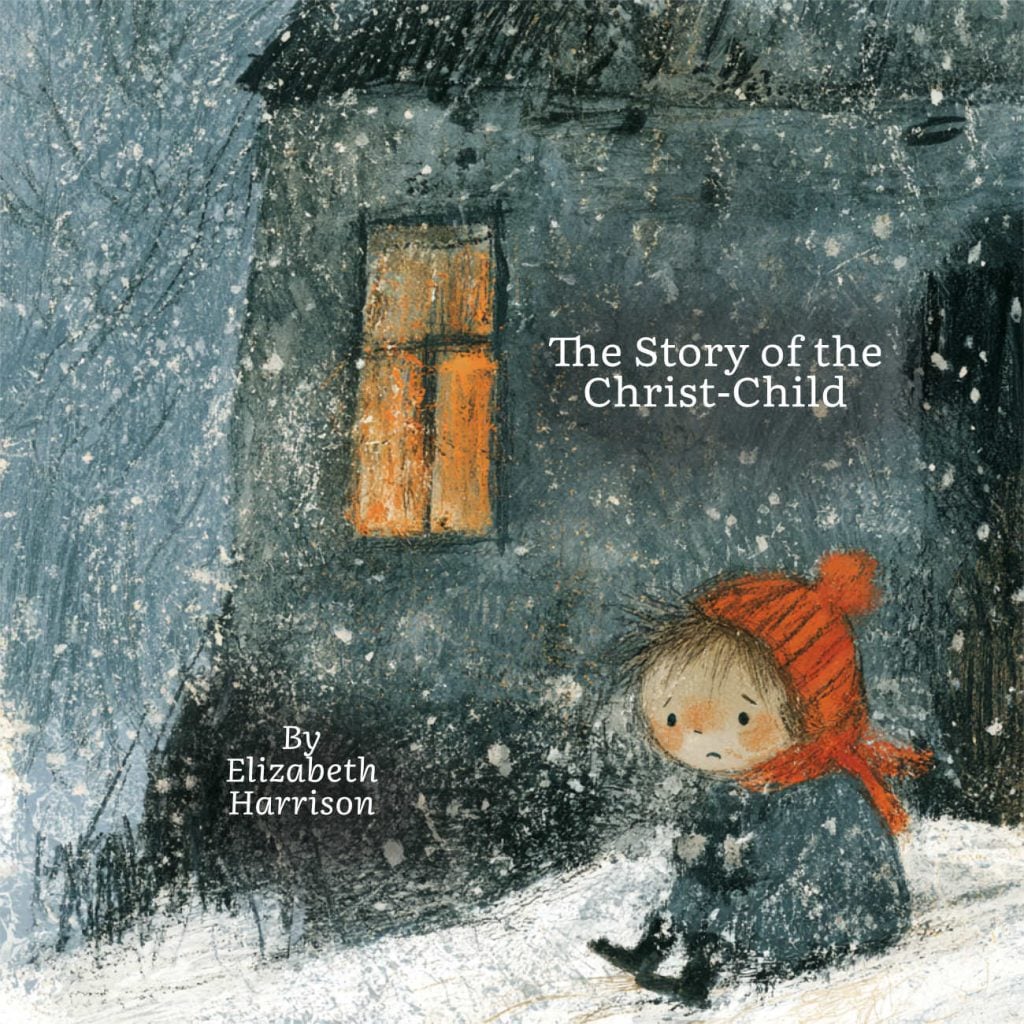
A Story of the Christ-Child
On a bitter Christmas Eve, a lonely child searches for somewhere warm and welcoming. Door after door closes, until a family with very little invites him inside. This classic Christmas story for children follows an unexpected visitor and a remarkable act of kindness that changes the family’s night.
Read
Read the story at your own pace.
Once upon a time, a long, long time ago, on the night before Christmas, a little child was wandering all alone through the streets of a great city. There were many people on the street, fathers and mothers, sisters and brothers, uncles and aunts, and even gray-haired grandfathers and grandmothers, all of whom were hurrying home with bundles of presents for each other and for their little ones. Fine carriages rolled by, express wagons rattled past, even old carts were pressed into service, and all things seemed in a hurry and glad with expectation of the coming Christmas morning.
From some of the windows bright lights were already beginning to stream until it was almost as bright as day. But the little child seemed to have no home, and wandered about listlessly from street to street. No one took any notice of him except perhaps Jack Frost, who bit his bare toes and made the ends of his fingers tingle. The north wind, too, seemed to notice the child, for it blew against him and pierced his ragged garments through and through, causing him to shiver with cold. Home after home he passed, looking with longing eyes through the windows, in upon the glad, happy children, most of whom were helping to trim the Christmas trees for the coming morrow.
“Surely,” said the child to himself, “where there is so must gladness and happiness, some of it may be for me.” So with timid steps he approached a large and handsome house.
Through the windows, he could see a tall and stately Christmas tree already lighted. Many presents hung upon it. Its green boughs were trimmed with gold and silver ornaments. Slowly he climbed up the broad steps and gently rapped at the door. It was opened by a large man-servant. He had a kindly face, although his voice was deep and gruff. He looked at the little child for a moment, then sadly shook his head and said:
“Go down off the steps. There is no room here for such as you.”
He looked sorry as he spoke; possibly he remembered his own little ones at home, and was glad that they were not out in this cold and bitter night. Through the open door a bright light shone, and the warm air, filled with fragrance of the Christmas pine, rushed out from the inner room and greeted the little wanderer with a kiss. As the child turned back into the cold and darkness, he wondered why the footman had spoken thus, for surely, thought he, those little children would love to have another companion join them in their joyous Christmas festival. But the little children inside did not even know that he had knocked at the door.
The street grew colder and darker as the child passed on. He went sadly forward, saying to himself:
“Is there no one in all this great city who will share the Christmas with me?”
Farther and farther down the street he wandered, to where the homes were not so large and beautiful. There seemed to be little children inside of nearly all the houses. They were dancing and frolicking about. Christmas trees could be seen in nearly every window, with beautiful dolls and trumpets and picture-books and balls and tops and other dainty toys hung upon them. In one window the child noticed a little lamb made of soft white wool. Around its neck was tied a red ribbon. It had evidently been hung on the tree for one of the children. The little stranger stopped before this window and looked long and earnestly at the beautiful things inside, but most of all was he drawn toward the white lamb.
At last creeping up to the window-pane, he gently tapped upon it. A little girl came to the window and looked out into the dark street where the snow had now begun to fall. She saw the child, but she only frowned and shook her head and said:
“Go away and come some other time. We are too busy to take care of you now.”
Back into the dark, cold streets he turned again. The wind was whirling past him and seemed to say, “Hurry on, hurry on, we have no time to stop. ‘Tis Christmas Eve and everybody is in a hurry to-night.”
Again and again the little child rapped softly at door or window-pane. At each place he was refused admission. One mother feared he might have some ugly disease which her darlings would catch; another father said he had only enough for his own children and none to spare for beggars. Still another told him to go home where he belonged, and not to trouble other folks.
The hours passed; later grew the night, and colder grew the wind, and darker seemed the street. Farther and farther the little one wandered. There was scarcely any one left upon the street by this time, and the few who remained did not seem to see the child, when suddenly ahead of him there appeared a bright, single ray of light. It shone through the darkness into the child’s eyes. He looked up smilingly and said, “I will go where the small light beckons, perhaps they will share their Christmas with me.”
Hurrying past all the other houses, he soon reached the end of the street and went straight up to the window from which the light was streaming. It was a poor, little, low house, but the child cared not for that. The light seemed still to call him in. From what do you suppose the light came? Nothing but a tallow candle which had been placed in an old cup with a broken handle, in the window, as a glad token of Christmas Eve. There was neither curtain nor shade to the small, square window and as the little child looked in he saw standing upon a neat wooden table a branch of a Christmas tree. The room was plainly furnished but it was very clean. Near the fireplace sat a lovely faced mother with a little two-year-old on her knee and an older child beside her. The two children were looking into their mother’s face and listening to a story. She must have been telling them a Christmas story, I think. A few bright coals were burning in the fireplace, and all seemed light and warm within.
The little wanderer crept closer and closer to the window-pane. So sweet was the mother’s face, so loving seemed the little children, that at last he took courage and tapped gently, very gently on the door. The mother stopped talking, the little children looked up.
“What was that, mother?” asked the little girl at her side.
“I think it was some one tapping on the door,” replied the mother.
“Run as quickly as you can and open it, dear, for it is a bitter cold night to keep any one waiting in this storm.”
“Oh, mother, I think it was the bough of the tree tapping against the window-pane,” said the little girl. “Do please go on with our story.”
Again the little wanderer tapped upon the door.
“My child, my child,” exclaimed the mother, rising, “that certainly was a rap on the door. Run quickly and open it. No one must be left out in the cold on our beautiful Christmas Eve.”
The child ran to the door and threw it wide open. The mother saw the ragged stranger standing without, cold and shivering, with bare head and almost bare feet. She held out both hands and drew him into the warm, bright room.
“You poor, dear child,” was all she said, and putting her arms around him, she drew him close to her breast. “He is very cold, my children,” she exclaimed. “We must warm him.”
“And,” added the little girl, “we must love him and give him some of our Christmas, too.”
“Yes,” said the mother, “but first let us warm him—”
The mother sat down by the fire with the little child on her lap, and her own little ones warmed his half-frozen hands in theirs. The mother smoothed his tangled curls, and, bending low over his head, kissed the child’s face. She gathered the three little ones in her arms and the candle and the fire light shone over them. For a moment the room was very still. By and by the little girl said softly, to her mother:
“May we not light the Christmas tree, and let him see how beautiful it looks?”
“Yes,” said the mother. With that she seated the child on a low stool beside the fire, and went herself to fetch the few simple ornaments which from year to year she had saved for her children’s Christmas tree. They were soon so busy that they did not notice the room had filled with a strange and brilliant light. They turned and looked at the spot where the little wanderer sat. His ragged clothes had changed to garments white and beautiful; his tangled curls seemed like a halo of golden light about his head; but most glorious of all was his face, which shone with a light so dazzling that they could scarcely look upon it.
In silent wonder they gazed at the child. Their little room seemed to grow larger and larger, until it was as wide as the whole world, the roof of their low house seemed to expand and rise, until it reached to the sky.
With a sweet and gentle smile the wonderful child looked upon them for a moment, and then slowly rose and floated through the air, above the treetops, beyond the church spire, higher even than the clouds themselves, until he appeared to them to be a shining star in the sky above. At last he disappeared from sight. The astonished children turned in hushed awe to their mother, and said in a whisper:
“Oh, mother, it was the Christ-Child, was it not?”
And the mother answered in a low tone, “Yes.”
And it is said, dear children, that each Christmas Eve the little Christ-Child wanders through some town or village, and those who receive him and take him into their homes and hearts have given to them this marvellous vision which is denied to others.
Copyright © Storyberries
Explore the story
Context
Explore the ideas, feelings and learning behind the story.
A Story of the Christ-Child is a Christmas legend told through contrasting scenes of warmth and cold, welcome and rejection. Elizabeth Harrison adapted the tale from a German tradition; a version titled The Legend of the Christ Child was published in the nineteenth century.
The unnamed child passes prosperous homes filled with presents before reaching a modest house lit by one candle. The mother and her children offer shelter without expecting a reward. When the visitor changes into a radiant figure, the story makes its Christian meaning explicit.
For family reading or the classroom, the repeated refusals invite comparisons of characters’ choices. Children can explore empathy, generosity and the difference between having plenty to give and choosing to share what one has.
Vocabulary
Discover useful new words and what they mean.
- Listlessly
- Without much energy, purpose or enthusiasm.
- Stately
- Grand, impressive or dignified.
- Boughs
- The larger branches of a tree.
- Frolicking
- Playing, jumping or moving about cheerfully.
- Beckons
- Signals or seems to invite someone to come nearer.
- Tallow
- Animal fat once used to make candles.
- Garments
- Items of clothing.
- Halo
- A ring or glow of light often shown around a holy figure.
- Marvellous
- Wonderful, surprising or extraordinary.
Discussion questions
Use the story to spark thoughtful, imaginative conversations.
Empathy
- How might the child feel when he watches happy families through their windows but cannot join them?
- Which detail about the cold or the child’s clothing most clearly helps you imagine his experience?
- How could someone notice a person who feels left out, even when everyone else is busy?
Kindness
- What does the mother do first when she discovers someone waiting outside in the storm?
- How does the little girl’s attitude change between hearing the knock and welcoming the child?
- What small act of kindness could make someone feel included during a celebration?
Generosity
- Why does the family share Christmas even though its home and decorations are simple?
- What is the difference between giving a present and sharing time, warmth or attention?
- What can someone offer when they do not have money or expensive gifts to spare?
Love
- How do the mother and children show the visitor that he matters to them?
- Why do you think their actions become more important than the beautiful things in the other houses?
- How might the story’s ending change the way the family celebrates Christmas in the future?
Frequently Asked Questions
Helpful answers for parents and teachers.
What happens in A Story of the Christ-Child?
A child walks through a city on Christmas Eve seeking warmth and companionship, but people at several homes turn him away. At last, a mother and her two children welcome him into their small house and warm his hands. As they prepare their modest Christmas tree, the stranger is revealed as the Christ-Child. The tale asks readers to consider who receives kindness when celebrations become busy.
Who is the mysterious visitor in the story?
The visitor is revealed at the end to be the Christ-Child, although the family initially sees only an exhausted little stranger in ragged clothing. His transformation into a radiant figure makes the surprise unmistakable. The story deliberately delays this revelation so readers can judge the family’s choice before knowing who the child is. You might ask children whether the mother would have acted differently if she had known.
Why is the poorest household the one that welcomes him?
The contrast suggests that having money or abundant decorations does not automatically lead to generosity. Families in larger houses turn the child away, while the mother in the simple home immediately offers warmth and invites him inside. Her actions, rather than her possessions, distinguish her. To explore this point further, you can compare the characters’ choices with other stories about generosity.
What does the candle in the small window represent?
The candle is a practical light that draws the lost child towards the final house, but it can also be read as a symbol of welcome and hope. It sits in a broken cup, emphasising that the family has little to display. Ask children why a single light might matter more to the wandering child than the brightly decorated windows of the richer homes.
Why does the story mention the white woollen lamb?
The lamb is a toy hanging on a Christmas tree in one of the homes that refuses the child entry. It attracts his attention, showing that he longs to share the same ordinary pleasures as other children. Readers may also notice a connection between the lamb and Christian imagery, although the text does not explain that symbolism. This makes it an opportunity to distinguish a detail the author states from a meaning readers infer.
How can adults discuss the rejection of the child sensitively?
The story contains several unkind refusals, an intense winter storm and a child who appears homeless, so it may prompt difficult questions. Invite children to describe his feelings without making them responsible for solving homelessness. Discuss safe, realistic ways families and communities help people in need, then return to the mother’s welcoming actions. More kindness stories can extend the conversation.
Is this the biblical story of Jesus’ birth?
No. This is a fictional Christian Christmas legend rather than a retelling of the biblical Nativity. The child appears on a later Christmas Eve in an unnamed city, and the narrative focuses on people’s responses to a stranger. The ending uses the Christ-Child to communicate a religious meaning about hospitality and love. Readers can compare it with other Christmas stories.
Where did Elizabeth Harrison’s version come from?
Elizabeth Harrison adapted the story from a German Christmas legend. National Louis University preserves a copy of The Legend of the Christ Child dated 1891, identifying Harrison and the Chicago Kindergarten Training School. This is useful background when explaining why the tale has older expressions and a traditional storyteller’s ending. Storyberries also has an Elizabeth Harrison author archive.
Which literacy skills can teachers practise with this story?
The repeated visits to different homes make the story useful for sequencing, comparing settings and predicting what may happen next. Older readers can examine words such as “listlessly”, “tallow” and “stately”, then identify contrasts between light and darkness. The delayed revelation also supports discussion of clues and narrative suspense. A simple activity is to make a two-column chart comparing the first homes with the final house.
What other Christmas stories could families read alongside it?
For a contrast in characters and tone, families can read Jimmy Scarecrow’s Christmas, another Christmas story featuring a character who longs to be noticed. Storyberries’ Christmas story collection offers further seasonal choices. A useful comparison question is how each story shows someone being overlooked and what finally changes that person’s Christmas.
Credits
Meet the people who brought A Story of the Christ-Child to life.
Story by Elizabeth Harrison.
Adapted from a German Christmas legend.

Copyright © Storyberries