
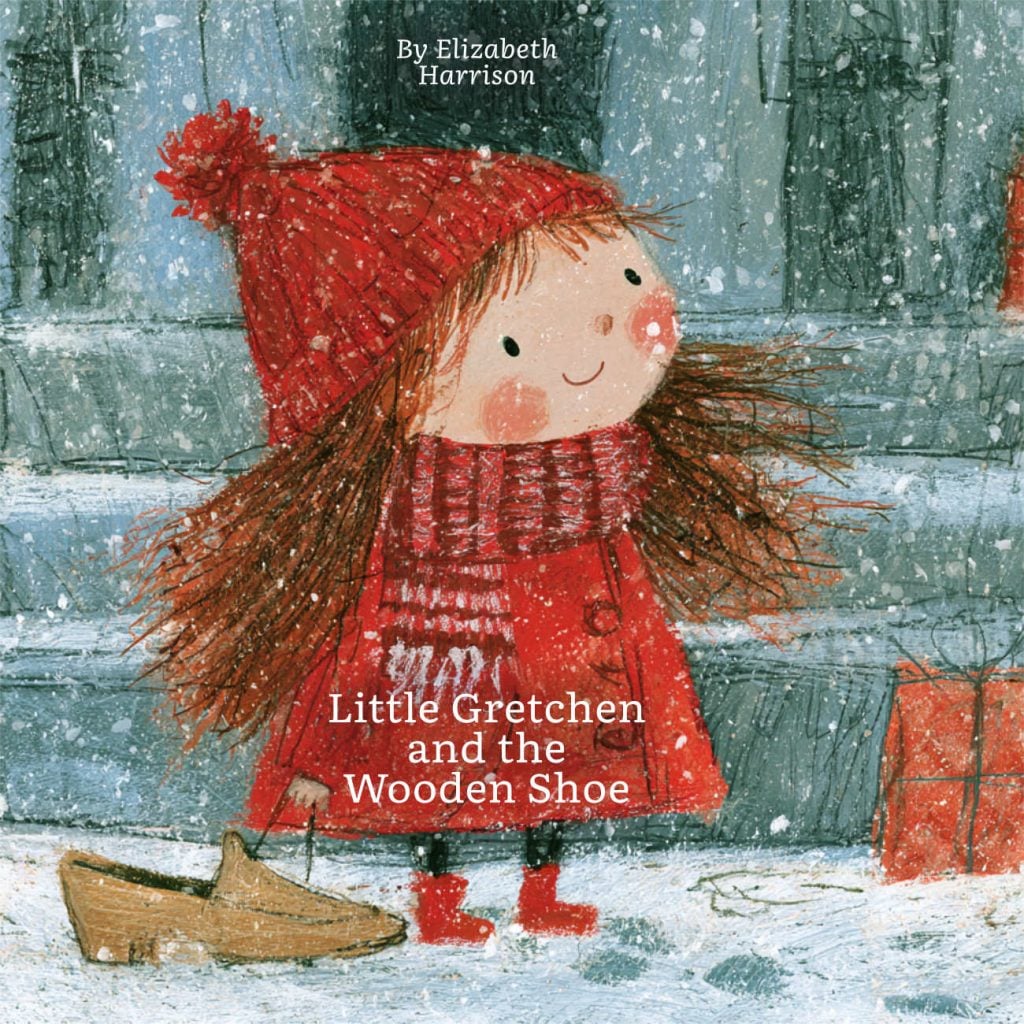
Little Gretchen and the Wooden Shoe
In a snowy German forest, Little Gretchen and Granny Goodyear have barely enough money to get by, let alone buy Christmas toys. But Gretchen fills their cottage with evergreen decorations and leaves a wooden shoe outside for the Christmas angels—unaware that a tiny visitor will change her Christmas morning.
Read
Read the story at your own pace.
Once upon a time, a long time ago, far away across the great ocean, in a country called Germany, there could be seen a small log hut on the edge of a great forest, whose fir-trees extended for miles and miles to the north.
This little house, made of heavy hewn logs, had but one room in it. A rough pine door gave entrance to this room, and a small square window admitted the light. At the back of the house was built an old-fashioned stone chimney, out of which in winter usually curled a thin, blue smoke, showing that there was not very much fire within.
Small as the house was, it was large enough for the two people who lived in it. I want to tell you a story to-day about these two people. One was an old, gray-haired woman, so old that the little children of the village, nearly half a mile away, often wondered whether she had come into the world with the huge mountains, and the great fir-trees, which stood like giants back of her small hut.
Her face was wrinkled all over with deep lines, which, if the children could only have read aright, would have told them of many years of cheerful, happy, self-sacrifice, of loving, anxious watching beside sick-beds, of quiet endurance of pain, of many a day of hunger and cold, and of a thousand deeds of unselfish love for other people; but, of course, they could not read this strange handwriting. They only knew that she was old and wrinkled, and that she stooped as she walked. None of them seemed to fear her, for her smile was always cheerful, and she had a kindly word for each of them if they chanced to meet her on her way to and from the village.
With this old, old woman lived a very little girl. So bright and happy was she that the travellers who passed by the lonesome little house on the edge of the forest often thought of a sunbeam as they saw her. These two people were known in the village as Granny Goodyear and Little Gretchen.
The winter had come and the frost had snapped off many of the smaller branches from the pine-trees in the forest. Gretchen and her Granny were up by daybreak each morning. After their simple breakfast of oatmeal, Gretchen would run to the little closet and fetch Granny’s old woollen shawl, which seemed almost as old as Granny herself. Gretchen always claimed the right to put the shawl over her Granny’s head, even though she had to climb onto the wooden bench to do it. After carefully pinning it under Granny’s chin, she gave her a good-bye kiss, and Granny started out for her morning’s work in the forest.
This work was nothing more nor less than the gathering up of the twigs and branches which the autumn winds and winter frosts had thrown upon the ground. These were carefully gathered into a large bundle which Granny tied together with a strong linen band. She then managed to lift the bundle to her shoulder and trudged off to the village with it.
Here she sold the fagots for kindling wood to the people of the village. Sometimes she would get only a few pence each day, and sometimes a dozen or more, but on this money little Gretchen and she managed to live; they had their home, and the forest kindly furnished the wood for the fire which kept them warm in cold weather.
In the summer time Granny had a little garden at the back of the hut where she raised, with little Gretchen’s help, a few potatoes and turnips and onions. These she carefully stored away for winter use. To this meagre supply, the pennies, gained by selling the twigs from the forest, added the oatmeal for Gretchen and a little black coffee for Granny. Meat was a thing they never thought of having. It cost too much money. Still, Granny and Gretchen were very happy, because they loved each other dearly.
Sometimes Gretchen would be left alone all day long in the hut, because Granny would have some work to do in the village after selling her bundle of sticks and twigs. It was during these long days that little Gretchen had taught herself to sing the song which the wind sang to the pine branches. In the summer time she learned the chirp and twitter of the birds, until her voice might almost be mistaken for a bird’s voice; she learned to dance as the swaying shadows did, and even to talk to the stars which shone through the little square window when Granny came home too late or too tired to talk.
Sometimes, when the weather was fine, or her Granny had an extra bundle of newly knitted stockings to take to the village, she would let little Gretchen go along with her. It chanced that one of these trips to the town came just the week before Christmas, and Gretchen’s eyes were delighted by the sight of the lovely Christmas-trees which stood in the window of the village store. It seemed to her that she would never tire of looking at the knit dolls, the woolly lambs, the little wooden shops with their queer, painted men and women in them, and all the other fine things. She had never owned a plaything in her whole life; therefore, toys which you and I would not think much of, seemed to her to be very beautiful.
That night, after their supper of baked potatoes was over, and little Gretchen had cleared away the dishes and swept up the hearth, because Granny dear was so tired, she brought her own small wooden stool and placed it very near Granny’s feet and sat down upon it, folding her hands on her lap. Granny knew that this meant she wanted to talk about something, so she smilingly laid away the large Bible which she had been reading, and took up her knitting, which was as much as to say: “Well, Gretchen, dear, Granny is ready to listen.”
“Granny,” said Gretchen slowly, “it’s almost Christmas time, isn’t it?”
“Yes, dearie,” said Granny, “only five more days now,” and then she sighed, but little Gretchen was so happy that she did not notice Granny’s sigh.
“What do you think, Granny, I’ll get this Christmas?” said she, looking up eagerly into Granny’s face.
“Ah, child, child,” said Granny, shaking her head, “you’ll have no Christmas this year. We are too poor for that.”
“Oh, but, Granny,” interrupted little Gretchen, “think of all the beautiful toys we saw in the village to-day. Surely Santa Claus has sent enough for every little child.”
“Ah, dearie,” said Granny, “those toys are for people who can pay money for them, and we have no money to spend for Christmas toys.”
“Well, Granny,” said Gretchen, “perhaps some of the little children who live in the great house on the hill at the other end of the village will be willing to share some of their toys with me. They will be so glad to give some to a little girl who has none.”
“Dear child, dear child,” said Granny, leaning forward and stroking the soft, shiny hair of the little girl, “your heart is full of love. You would be glad to bring a Christmas to every child; but their heads are so full of what they are going to get that they forget all about anybody else but themselves.” Then she sighed and shook her head.
“Well, Granny,” said Gretchen, her bright, happy tone of voice growing a little less joyous, “perhaps the dear Santa Claus will show some of the village children how to make presents that do not cost money, and some of them may surprise me Christmas morning with a present. And, Granny, dear,” added she, springing up from her low stool, “can’t I gather some of the pine branches and take them to the old sick man who lives in the house by the mill, so that he can have the sweet smell of our pine forest in his room all Christmas day?”
“Yes, dearie,” said Granny, “you may do what you can to make the Christmas bright and happy, but you must not expect any present yourself.”
“Oh, but, Granny,” said little Gretchen, her face brightening, “you forget all about the shining Christmas angels, who came down to earth and sang their wonderful song the night the beautiful Christ-Child was born! They are so loving and good that they will not forget any little child. I shall ask my dear stars to-night to tell them of us. You know,” she added, with a look of relief, “the stars are so very high that they must know the angels quite well, as they come and go with their messages from the loving God.”
Granny sighed, as she half whispered, “Poor child, poor child!” but Gretchen threw her arm around Granny’s neck and gave her a hearty kiss, saying as she did so: “Oh, Granny, Granny, you don’t talk to the stars often enough, else you wouldn’t be sad at Christmas time.” Then she danced all around the room, whirling her little skirts about her to show Granny how the wind had made the snow dance that day. She looked so droll and funny that Granny forgot her cares and worries and laughed with little Gretchen over her new snow-dance.
The days passed on, and the morning before Christmas Eve came. Gretchen having tidied up the little room—for Granny had taught her to be a careful little housewife—was off to the forest, singing a birdlike song, almost as happy and free as the birds themselves. She was very busy that day, preparing a surprise for Granny. First, however, she gathered the most beautiful of the fir branches within her reach to take the next morning to the old sick man who lived by the mill. The day was all too short for the happy little girl. When Granny came trudging wearily home that night, she found the frame of the doorway covered with green pine branches.
“It’s to welcome you, Granny! It’s to welcome you!” cried Gretchen; “our old dear home wanted to give you a Christmas welcome. Don’t you see, the branches of evergreen make it look as if it were smiling all over, and it is trying to say, ‘A happy Christmas’ to you, Granny!”
Granny laughed and kissed the little girl, as they opened the door and went in together. Here was a new surprise for Granny. The four posts of the wooden bed, which stood in one corner of the room, had been trimmed by the busy little fingers, with smaller and more flexible branches of the pine-trees. A small bouquet of red mountain-ash berries stood at each side of the fireplace, and these, together with the trimmed posts of the bed, gave the plain old room quite a festival look.
Gretchen laughed and clapped her hands and danced about until the house seemed full of music to poor, tired Granny, whose heart had been sad as she turned toward their home that night, thinking of the disappointment which must come to loving little Gretchen the next morning.
After supper was over little Gretchen drew her stool up to Granny’s side, and laying her soft, little hands on Granny’s knee, asked to be told once again the story of the coming of the Christ-Child; how the night that he was born the beautiful angels had sung their wonderful song, and how the whole sky had become bright with a strange and glorious light, never seen by the people of earth before. Gretchen had heard the story many, many times before, but she never grew tired of it, and now that Christmas Eve had come again, the happy little child wanted to hear it once more.
When Granny had finished telling it the two sat quiet and silent for a little while thinking it over; then Granny rose and said that it was time for them to go to bed. She slowly took off her heavy wooden shoes, such as are worn in that country, and placed them beside the hearth. Gretchen looked thoughtfully at them for a minute or two, and then she said, “Granny, don’t you think that somebody in all this wide world will think of us to-night?”
“Nay, Gretchen,” said Granny, “I don’t think any one will.”
“Well, then, Granny,” said Gretchen, “the Christmas angels will, I know; so I am going to take one of your wooden shoes, and put it on the windowsill outside, so that they may see it as they pass by. I am sure the stars will tell the Christmas angels where the shoe is.”
“Ah, you foolish, foolish child,” said Granny, “you are only getting ready for a disappointment To-morrow morning there will be nothing whatever in the shoe. I can tell you that now.”
But little Gretchen would not listen. She only shook her head and cried out: “Ah, Granny, you don’t talk enough to the stars.” With this she seized the shoe, and, opening the door, hurried out to place it on the windowsill.
It was very dark without, and something soft and cold seemed to gently kiss her hair and face. Gretchen knew by this that it was snowing, and she looked up to the sky, anxious to see if the stars were in sight, but a strong wind was tumbling the dark, heavy snow-clouds about and had shut away all else.
“Never mind,” said Gretchen softly to herself, “the stars are up there, even if I can’t see them, and the Christmas angels do not mind snowstorms.”
Just then a rough wind went sweeping by the little girl, whispering something to her which she could not understand, and then it made a sudden rush up to the snow-clouds and parted them, so that the deep, mysterious sky appeared beyond, and shining down out of the midst of it was Gretchen’s favourite star.
“Ah, little star, little star!” said the child, laughing aloud, “I knew you were there, though I couldn’t see you. Will you whisper to the Christmas angels as they come by that little Gretchen wants so very much to have a Christmas gift to-morrow morning, if they have one to spare, and that she has put one of Granny’s shoes upon the windowsill ready for it?”
A moment more and the little girl, standing on tiptoe, had reached the windowsill and placed the shoe upon it, and was back again in the house beside Granny and the warm fire.
The two went quietly to bed, and that night as little Gretchen knelt to pray to the Heavenly Father, she thanked him for having sent the Christ-Child into the world to teach all mankind how to be loving and unselfish, and in a few moments she was quietly sleeping, dreaming of the Christmas angels.
The next morning, very early, even before the sun was up, little Gretchen was awakened by the sound of sweet music coming from the village. She listened for a moment and then she knew that the choir-boys were singing the Christmas carols in the open air of the village street. She sprang up out of bed and began to dress herself as quickly as possible, singing as she dressed. While Granny was slowly putting on her clothes, little Gretchen, having finished dressing herself, unfastened the door and hurried out to see what the Christmas angels had left in the old wooden shoe.
The white snow covered everything—trees, stumps, roads, and pastures—until the whole world looked like fairyland. Gretchen climbed up on a large stone which was beneath the window and carefully lifted down the wooden shoe. The snow tumbled off of it in a shower over the little girl’s hands, but she did not heed that; she ran hurriedly back into the house, putting her hand into the toe of the shoe as she ran.
“Oh, Granny! Oh, Granny!” she exclaimed, “you didn’t believe the Christmas angels would think about us, but see, they have, they have! Here is a dear little bird nestled down in the toe of your shoe! Oh, isn’t he beautiful?”
Granny came forward and looked at what the child was holding lovingly in her hand. There she saw a tiny chick-a-dee, whose wing was evidently broken by the rough and boisterous winds of the night before, and who had taken shelter in the safe, dry toe of the old wooden shoe. She gently took the little bird out of Gretchen’s hands, and skilfully bound his broken wing to his side, so that he need not hurt himself by trying to fly with it. Then she showed Gretchen how to make a nice warm nest for the little stranger, close beside the fire, and when their breakfast was ready she let Gretchen feed the little bird with a few moist crumbs.
Later in the day Gretchen carried the fresh, green boughs to the old sick man by the mill, and on her way home stopped to see and enjoy the Christmas toys of some other children whom she knew, never once wishing that they were hers. When she reached home she found that the little bird had gone to sleep. Soon, however, he opened his eyes and stretched his head up, saying just as plain as a bird could say, “Now, my new friends, I want you to give me something more to eat.”
Gretchen gladly fed him again, and then, holding him in her lap, she softly and gently stroked his gray feathers until the little creature seemed to lose all fear of her. That evening Granny taught her a Christmas hymn and told her another beautiful Christmas story. Then Gretchen made up a funny little story to tell to the birdie. He winked his eyes and turned his head from side to side in such a droll fashion that Gretchen laughed until the tears came.
As Granny and she got ready for bed that night, Gretchen put her arms softly around Granny’s neck, and whispered: “What a beautiful Christmas we have had to-day, Granny! Is there anything in the world more lovely than Christmas?”
“Nay, child, nay,” said Granny, “not to such loving hearts as yours.”
Copyright © Storyberries
Explore the story
Context
Explore the ideas, feelings and learning behind the story.
This classic Christmas tale follows Little Gretchen and Granny Goodyear, who live modestly beside a German forest. The setting, wooden shoes, evergreen branches and carolling create a winter holiday atmosphere, while the family’s lack of money shapes the story’s central problem.
Although Gretchen hopes the Christmas angels will bring a gift, she also decorates the cottage and plans to take pine boughs to a sick neighbour. When a wounded chickadee shelters in Granny’s shoe, Gretchen welcomes the unexpected responsibility of caring for it.
The story invites children to distinguish wanting a present from noticing what someone else needs. It can prompt conversations about family love, gratitude, hope, and ways to make celebrations meaningful without buying things.
Vocabulary
Discover useful new words and what they mean.
- Hewn
- Cut and shaped with a tool, especially when working with wood.
- Fagots
- An old-fashioned word for bundles of sticks used as firewood.
- Kindling
- Small, dry wood used to start a fire.
- Meagre
- Small in amount; not as much as someone might need.
- Hearth
- The floor or area beside a fireplace.
- Boughs
- Large branches of a tree.
- Evergreen
- A plant that stays green through the year.
- Boisterous
- Noisy, energetic or rough, like the strong wind in the story.
Discussion questions
Use the story to spark thoughtful, imaginative conversations.
Gratitude
- What makes Gretchen describe Christmas as beautiful even without toys?
- How does she react when the wooden shoe contains a bird instead of a present?
- Which small comforts in Gretchen and Granny’s day might be easy to overlook?
Kindness
- What does Gretchen do for the sick man who lives by the mill?
- How do Gretchen and Granny help the chickadee after finding it in the shoe?
- If you were Gretchen’s neighbour, what simple act of kindness could you offer her family?
Generosity
- Why does Gretchen want to decorate her home and surprise Granny?
- What does giving someone your time or care look like in this story?
- Can a gift be valuable even if it costs no money? What examples would you give?
Optimism
- Why does Gretchen continue to hope when Granny expects disappointment?
- How do the stars and Christmas angels shape Gretchen’s expectations?
- When is hope helpful, and how might we respond kindly when our hopes are not fulfilled?
Frequently Asked Questions
Helpful answers for parents and teachers.
What happens at the end of Little Gretchen and the Wooden Shoe?
On Christmas morning, Gretchen finds a tiny chickadee sheltering in the wooden shoe she placed outside. Its wing has been injured by the storm, so Granny gently binds it and the two make a warm nest. Gretchen spends the day caring for the bird and helping a sick neighbour. Instead of receiving a toy, she discovers the pleasure of offering care.
Why does Gretchen leave a wooden shoe on the windowsill?
Gretchen believes the Christmas angels will remember her, even though Granny says they cannot afford gifts. She places one of Granny’s shoes outside so the angels will know where to leave a present. The shoe becomes a shelter for a bird during a snowstorm. You could ask children how the object’s purpose changes from the beginning of the night to the next morning.
Why does Granny worry that Christmas will disappoint Gretchen?
Granny earns very little by selling bundles of fallen branches and sometimes knitting stockings. She knows they cannot pay for the toys Gretchen admires in the village shop, and she fears the child will be heartbroken. Her worry comes from love rather than a lack of Christmas spirit. The story provides a starting point for discussing financial hardship with compassion rather than judgment.
What is the significance of the chickadee in the story?
The chickadee transforms Gretchen’s expectation of receiving into a chance to give. The bird does not arrive as a conventional wrapped present; it needs warmth, food and patient care. Gretchen sees its appearance as proof that she has not been forgotten. The ending allows readers to discuss whether a meaningful Christmas gift must be something you can keep or own.
How does the story explore gratitude without expensive gifts?
Gretchen is delighted by decorating the cottage, spending time with Granny and helping a bird. Even when she sees other children’s toys, she does not wish to take them home. Gratitude here is not a denial that poverty is difficult; it is her ability to recognise affection and purpose alongside hardship. For other stories using this theme, explore gratitude stories for children.
How does the relationship between Gretchen and Granny shape the ending?
Their bond gives the story emotional weight. Gretchen helps Granny with household tasks and secretly decorates the hut, while Granny provides food, warmth, stories and practical help for the injured chickadee. Each looks after the other in a different way. Readers can compare their relationship with the many forms of care shown in stories about grandparents.
How can families use this story to talk about generosity at Christmas?
Start with Gretchen gathering fragrant fir branches for the sick man by the mill. Unlike a shop-bought toy, her gift uses thought, effort and something she can collect freely. Invite children to make a list of gifts that cost little or nothing, such as visiting someone, creating a decoration or helping with a chore. The point is to consider what the recipient would genuinely enjoy.
Which old-fashioned words may need explaining to young readers?
Terms such as “fagots”, “hewn”, “meagre” and “hearth” reflect the older language of the text. In context, “fagots” means bundles of sticks sold as firewood. Read a short paragraph aloud and let children guess unfamiliar meanings before checking them together. You can also browse vintage stories for children to compare older vocabulary and sentence styles.
Is Little Gretchen and the Wooden Shoe based on a German traditional tale?
Elizabeth Harrison described hearing versions of the tale during childhood and associated it with German nursery and fireside storytelling. Her version appears in the 1902 collection Christmas-tide, so it is safest to describe this text as Harrison’s literary telling of an older traditional story, rather than assign it a particular folk-tale number. National Louis University preserves the historical collection.
How might teachers use this Christmas story in a reading lesson?
Ask pupils to trace how Gretchen’s idea of a Christmas present changes between seeing shop toys and finding the bird. They can highlight details about the setting, predict Granny’s response and explain the final line about loving hearts. For a thematic reading set, pair it with other Christmas stories for kids, while noting this particular story’s explicit Christian references.
Credits
Meet the people who brought Little Gretchen and the Wooden Shoe to life.
Story: Elizabeth Harrison
Historical publication: Christmas-tide (1902).

Copyright © Storyberries