
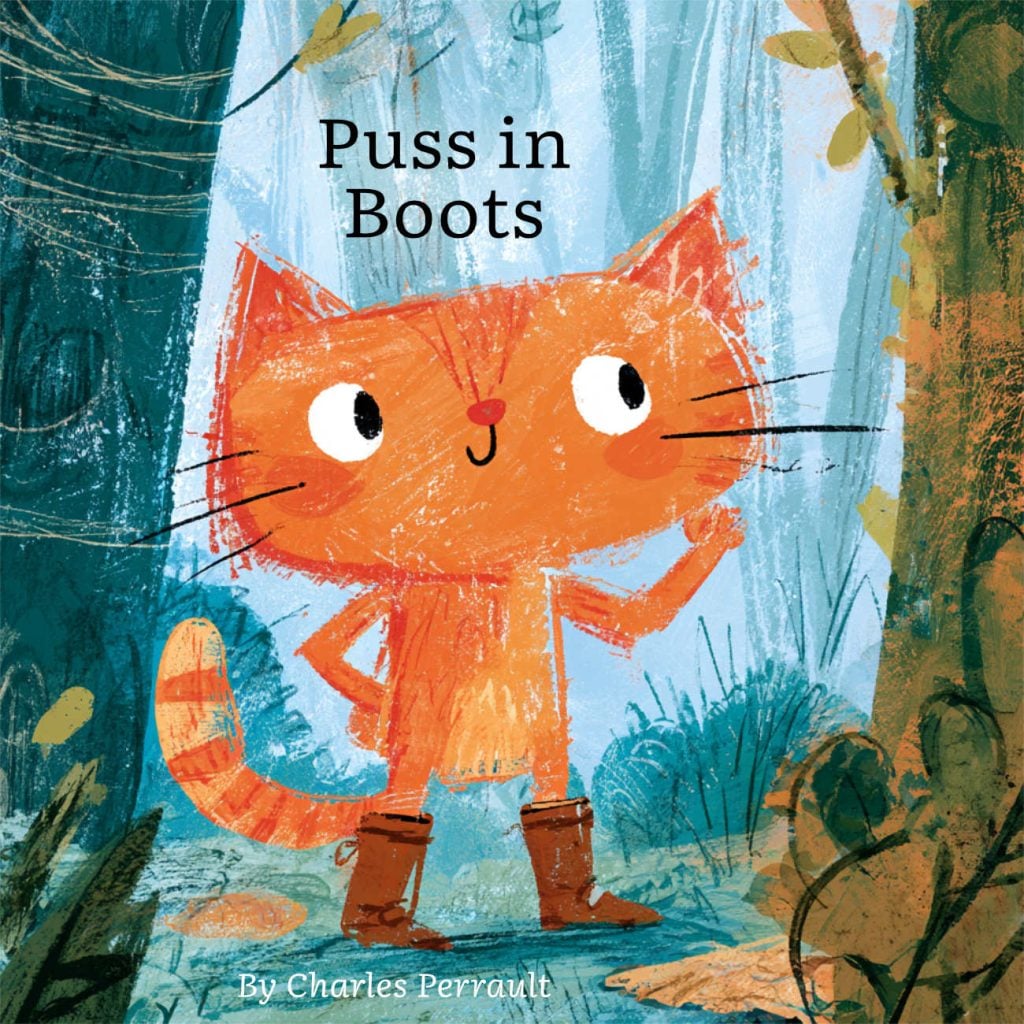
Puss in Boots
When a poor miller’s youngest son inherits nothing but a cat, he thinks his future looks hopeless. But this is no ordinary cat. With a pair of boots, a bag and a talent for clever schemes, Puss sets out to transform his master’s fortunes – using gifts, disguises, threats and one particularly daring trick involving a powerful Ogre.
Read ‘Puss in Boots’ online for free
There was once a miller who left nothing to his three sons other than what he had: his Mill, his Ass, and his Cat. The partition was soon made. Neither the scrivener nor attorney were sent for. They would soon have eaten up all the poor patrimony. The eldest had the Mill, the second the Ass, and the youngest nothing but the Cat.
The poor young fellow was quite comfortless at having so poor a lot.
“My brothers,” said he, “may get their living handsomely enough, by joining their stocks together; but for my part, when I have eaten up my Cat, and made me a muff of his skin, I must die with hunger.”
The Cat, who heard all this, but made as if he did not, said to him with a grave and serious air:
“Do not thus afflict yourself, my good master; you have only to give me a bag, and get a pair of boots made for me, that I may scamper through the dirt and the brambles, and you shall see that you have not so bad a portion of me as you imagine.”
Although the son did not build very much upon what he said, he had however often seen the Cat play a great many cunning tricks to catch rats and mice; as when he used to hang by the heels, or hide himself in the meal, and make as if he were dead; so that he did not altogether despair of his affording him some help in his miserable condition.
When the Cat had what he asked for, he booted himself very gallantly; and putting his bag about his neck, he held the strings of it in his two fore paws, and went into a warren where was great abundance of rabbits. He put bran and sow-thistle into his bag, and stretching himself out at length as if he had been dead, he waited for some young rabbit, not yet acquainted with the deceits of the world, to come and rummage his bag for what he had put into it.
Scarce was he lain down but he had what he wanted; a rash and foolish young rabbit jumped into his bag, and Monsieur Puss, immediately drawing close the strings, took and killed him without pity. Proud of his prey, he went with it to the palace, and asked to speak with his Majesty. He was showed up stairs into the King’s apartment, and, making a low reverence, said to him:
“I have brought you, sir, a rabbit of the warren which my noble lord the Marquis of Carabas” (for that was the title which Puss was pleased to give his master) “has commanded me to present to your Majesty from him.”
“Tell your master,” said the King, “that I thank him, and that he does me a great deal of pleasure.”
Another time he went and hid himself among some standing corn, holding his bag open; and when a brace of partridges ran into it, he drew the strings, and so caught them both. He went and made a present of these to the King, as he had done before of the rabbit. The King in like manner received the partridges with great pleasure, and ordered him some money to drink.
The Cat continued for two or three months, thus to carry his Majesty, from time to time, game of his master’s taking. One day in particular, when he knew for certain that the King was to take a walk along the river side, with his daughter, the most beautiful Princess in the world, he said to his master the Son:
“If you will follow my advice, your fortune is made. You have nothing else to do but go and wash yourself in the river, in the place that I show you. Leave the rest to me.”
The Son did what the Cat advised him to, without knowing why or wherefore.
While he was washing, the King passed by, and the Cat began to cry out, as loud as he could:
“Help, help, my lord Marquis of Carabas is drowning.”
At this noise the King put his head out of his coach-window, and finding it was the Cat who had so often brought him such good game, he commanded his guards to run immediately to the assistance of his lordship the Marquis of Carabas.
While they were drawing the poor Marquis out of the river, the Cat came up to the coach, and told the King that while his master was washing, there came by some rogues who went off with his clothes, though he had cried out “thieves! thieves!” several times, as loud as he could. (This cunning Cat had actually hidden the clothes under a great stone.)
The King immediately commanded the officers of his wardrobe to run and fetch one of his best suits for the lord Marquis of Carabas.
The King received him with great kindness, and as the fine clothes he had given him extremely set off his good appearance (for he was well made, and very handsome in his person), the King’s daughter took a secret inclination to him, and the Son had no sooner cast two or three respectful and somewhat tender glances, but she fell in love with him to distraction. The King then asked the Son to join him in his coach, and take a walk with them. The Cat, quite overjoyed to see his project begin to succeed, marched on before, and meeting with some countrymen, who were mowing a meadow, he said to them:
“Good people, you who are mowing, if you do not tell the King, that the meadow you mow belongs to my lord Marquis of Carabas, you shall be chopped as small as mince-meat.”
The King did not fail to ask the mowers whose meadow they were mowing.
“To my lord Marquis of Carabas,” answered they all together; for the Cat’s threats had made them terribly afraid.
“Truly a fine estate,” said the King to the Marquis of Carabas.
“You see, sir,” said the Son, “this is a meadow which never fails to yield a plentiful harvest every year.”
The Master Cat, who still went on ahead, met with some reapers, and said to them:
“Good people, you who are reaping, if you do not tell the King that all this corn belongs to the Marquis of Carabas, you shall be chopped as small as mince-meat.”
The King, who passed by a moment after, needed to know to whom all that corn he saw belonged.
“To my lord Marquis of Carabas,” replied the reapers; and the King again congratulated the Son.
The Master Cat, who went always before, said the same words to all he met; and the King was astonished at the vast estates of my lord Marquis of Carabas.
Monsieur Puss came at last to a stately castle, the master of which was an Ogre, the richest had ever been known; for all the lands which the King had then gone over belonged to this castle. The Cat, who had taken care to inform himself who this Ogre was, and what he could do, asked to speak with him, saying, he could not pass so near his castle without having the honour of paying his respects to him.
The Ogre received him as civilly as an Ogre could do, and made him sit down.
“I have been assured,” said the Cat, “that you have the gift of being able to change yourself into all sorts of creatures you have a mind to; you can, for example, transform yourself into a lion, or elephant, and the like.”
“This is true,” answered the Ogre very briskly, “and to convince you, you shall see me now become a lion.”
Puss was so sadly terrified at the sight of a lion so near him that he immediately got into the gutter, not without abundance of trouble and danger because of his boots, which were ill-suited for walking upon the tiles. A little while after, when Puss saw that the Ogre had resumed his natural form, he came down, and owned he had been very much frightened.
“I have been moreover informed,” said the Cat, “but I know not how to believe it, that you have also the power to take on you the shape of the smallest animals; for example, to change yourself into a rat or a mouse; but I must confess to you, I take this to be impossible.”
“Impossible?” cried the Ogre, “you shall see that presently,” and at the same time changed into a mouse, and began to run about the floor.
Puss no sooner perceived this, but he fell upon him, and ate him up.
Meanwhile the King, who saw as he passed this fine castle of the Ogre’s, had a mind to go into it.
Puss, who heard the noise of his Majesty’s coach running over the drawbridge, ran out and said to the King:
“Your Majesty is welcome to this castle of my lord Marquis of Carabas.”
“What! my lord Marquis?” cried the King, “and does this castle also belong to you? There can be nothing finer than this court, and all the stately buildings which surround it; let us go into it, if you please.”
The Son gave his hand to the Princess, and followed the King, who went up first. They passed into a spacious hall, where they found a magnificent collation which the Ogre had prepared for his friends, who were that very day to visit him, but dared not to enter knowing the King was there. His Majesty was perfectly charmed with the good qualities of my lord Marquis of Carabas, as was his daughter who was fallen violently in love with him; and seeing the vast estate he possessed, said to him, after having drank five or six glasses:
“I want you, my lord Marquis, to be my son-in-law.”
The Son, making several low bows, accepted the honour which his Majesty conferred upon him, and forthwith, that very same day, married the Princess.
Puss became a great lord, and never ran after mice any more, but only for his diversion.
Vocabulary
- Patrimony
- Property or possessions inherited from a parent or ancestor.
- Scrivener
- An old-fashioned term for someone employed to write or prepare documents.
- Warren
- An area of land where rabbits live and breed.
- Sow-thistle
- A leafy wild plant used by Puss to tempt the rabbit into his bag.
- Marquis
- A noble title traditionally ranking above a count and below a duke.
- Reverence
- A respectful bow or gesture.
- Collation
- In this older usage, a light meal or spread of food.
- Ogre
- A large and frightening human-like creature from fairy tales, often portrayed as dangerous or man-eating.
Context
Puss in Boots is a classic French fairy tale most closely associated with Charles Perrault, who included Le Maître Chat, ou le Chat Botté in his seventeenth-century collection of fairy tales. The story centers on a clever talking cat who uses deception, confidence and careful planning to transform the fortunes of his poor master.
Unlike many fairy tales in which goodness is rewarded directly, Puss in Boots creates more complicated questions about means and ends. Puss is loyal and resourceful, but he also lies, threatens workers and tricks both the King and the Ogre. This makes the story especially useful for older children because they can admire the Cat’s ingenuity while still questioning his methods.
The tale also explores appearances and social status: once the miller’s son receives fine clothes and the title “Marquis of Carabas,” he is treated as an important nobleman. Children can discuss why the King is so easily convinced by clothing, property and titles, and whether those things actually reveal someone’s character.
Let’s talk about ‘Puss in Boots’!
Spark a conversation with your child and connect the story to real-life lessons.
Fairness, Truthfulness
- Puss tells the workers to say that their fields belong to the Marquis of Carabas. Is it fair to frighten people into telling a lie?
- The miller’s youngest son receives only the Cat while his brothers receive the mill and the donkey. Do you think the inheritance was fair? Why?
- The Cat’s plans make his master rich, but other people lose something along the way. Should we think about who might be harmed when we try to improve our own situation?
Friendship
- Puss works very hard to improve his master’s life. What does this tell us about his loyalty?
- Is helping a friend always a good thing, even if the plan involves deceiving other people?
- What could Puss have done to help his master without frightening or misleading anyone?
Creativity
- Puss starts with very little: a bag, a pair of boots and his own ideas. Which of his plans do you think is the most inventive?
- Why do you think the Cat asks for boots before beginning his plan?
- Can clever thinking solve problems without using tricks or dishonesty? What alternative plan could you invent for Puss?
Independent Thinking
- The King believes everything Puss tells him. What questions could the King have asked before accepting the Cat’s claims?
- Why do the workers obey Puss even though they know that what he asks them to say is untrue?
- When someone tells us something confidently, how can we decide whether it is really true?
FAQs about ‘Puss in Boots’
What is Puss in Boots about?
Who wrote Puss in Boots?
Why does Puss ask for a pair of boots?
Why does Puss call his master the Marquis of Carabas?
Is Puss in Boots a good character?
Why does Puss trick the Ogre into becoming a mouse?
What lessons can children discuss after reading Puss in Boots?
Is Puss in Boots suitable for children?
How can teachers use Puss in Boots in the classroom?
Where can children find similar stories on Storyberries?
Aarne-Thompson-Uther classification
ATU 545B — Puss in Boots. This tale belongs to the internationally recognized Puss in Boots tale type. Typical elements include a poor young man inheriting a clever cat, the cat creating a noble identity for his master, presenting gifts to a ruler, tricking a powerful Ogre or magical landowner, acquiring his property and arranging the master’s marriage to a princess.
Credits
- Story by: Charles Perrault