
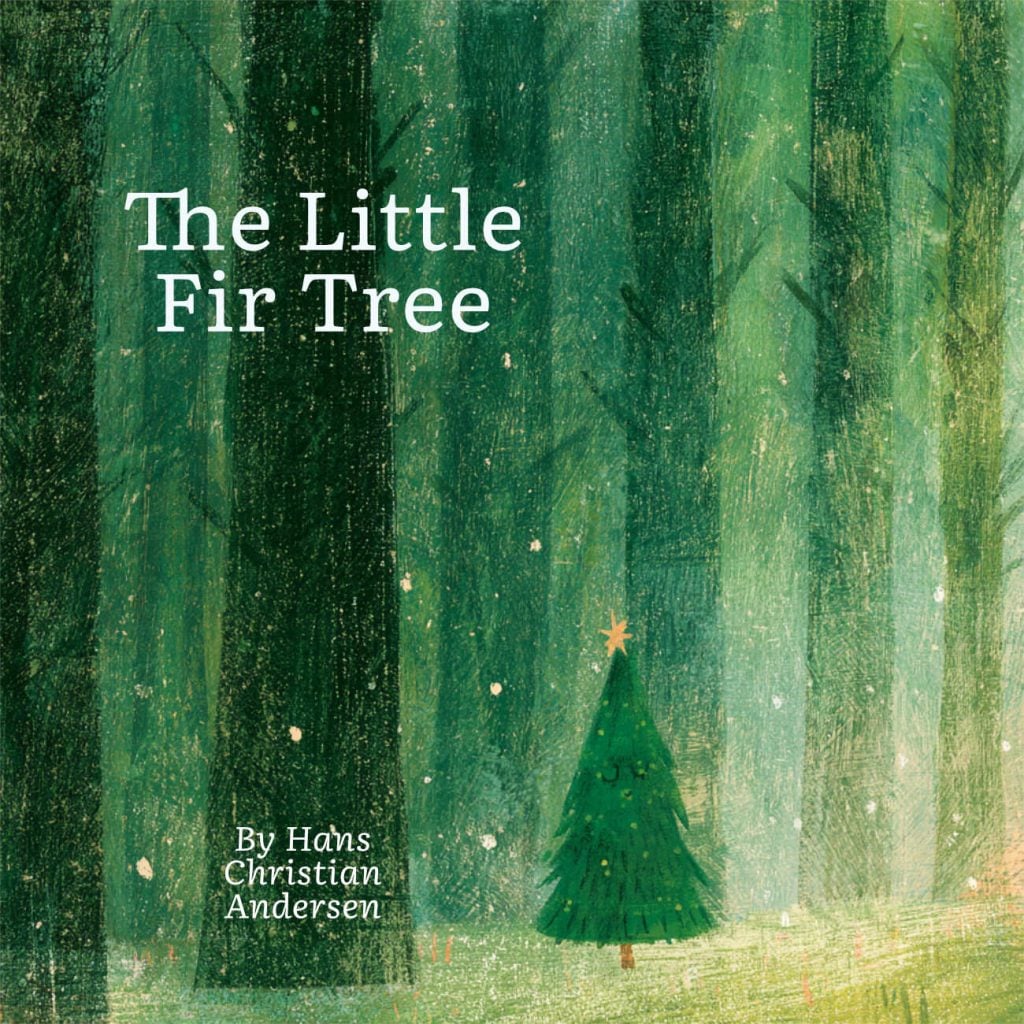
The Fir Tree
A little fir tree dreams of growing tall and becoming something extraordinary, but he overlooks the beauty of the forest around him. When Christmas finally brings the exciting change he has long imagined, Hans Christian Andersen’s bittersweet fairy tale asks whether happiness can be found by always wishing for tomorrow.
Read
Read the story at your own pace.
Far away in the forest, where the warm sun and the fresh air made a sweet resting place, grew a pretty little fir tree. The situation was all that could be desired; and yet the tree was not happy, it wished so much to be like its tall companions, the pines and firs which grew around it.

The sun shone, and the soft air fluttered its leaves, and the little peasant children passed by, prattling merrily; but the fir tree did not heed them.
Sometimes the children would bring a large basket of raspberries or strawberries, wreathed on straws, and seat themselves near the fir tree, and say, “Is it not a pretty little tree?” which made it feel even more unhappy than before.
And yet all this while the tree grew a notch or joint taller every year, for by the number of joints in the stem of a fir tree we can discover its age.
Still, as it grew, it complained: “Oh! how I wish I were as tall as the other trees; then I would spread out my branches on every side, and my crown would overlook the wide world around. I should have the birds building their nests on my boughs, and when the wind blew, I should bow with stately dignity, like my tall companions.”
So discontented was the tree, that it took no pleasure in the warm sunshine, the birds, or the rosy clouds that floated over it morning and evening.
Sometimes in winter, when the snow lay white and glittering on the ground, there was a little hare that would come springing along, and jump right over the little tree’s head; then how mortified it would feel.
Two winters passed; and when the third arrived, the tree had grown so tall that the hare was obliged to run round it. Yet it remained unsatisfied and would exclaim: “Oh! to grow, to grow; if I could but keep on growing tall and old! There is nothing else worth caring for in the world.”
In the autumn the woodcutters came, as usual, and cut down several of the tallest trees; and the young fir, which was now grown to a good, full height, shuddered as the noble trees fell to the earth with a crash.
After the branches were lopped off, the trunks looked so slender and bare that they could scarcely be recognized. Then they were placed, one upon another, upon wagons and drawn by horses out of the forest. Where could they be going? What would become of them? The young fir tree wished very much to know.
So in the spring, when the swallows and the storks came, it asked: “Do you know where those trees were taken? Did you meet them?”
The swallows knew nothing; but the stork, after a little reflection, nodded his head and said: “Yes, I think I do. As I flew from Egypt, I met several new ships, and they had fine masts that smelt like fir. These must have been the trees; and I assure you they were stately; they sailed right gloriously!”
“Oh, how I wish I were tall enough to go on the sea,” said the fir tree. “Tell me what is this sea, and what does it look like?”
“It would take too much time to explain—a great deal too much,” said the stork, flying quickly away.
“Rejoice in thy youth,” said the sunbeam; “rejoice in thy fresh growth and in the young life that is in thee.”
And the wind kissed the tree, and the dew watered it with tears, but the fir tree regarded them not.
Christmas time drew near, and many young trees were cut down, some that were even smaller and younger than the fir tree, who enjoyed neither rest nor peace for longing to leave its forest home. These young trees, which were chosen for their beauty, kept their branches, and they, also, were laid on wagons and drawn by horses far away out of the forest.
“Where are they going?” asked the fir tree. “They are not taller than I am; indeed, one is not so tall. And why do they keep all their branches? Where are they going?”
“We know, we know,” sang the sparrows; “we have looked in at the windows of the houses in the town, and we know what is done with them. Oh! you cannot think what honor and glory they receive. They are dressed up in the most splendid manner. We have seen them standing in the middle of a warm room, and adorned with all sorts of beautiful things—honey cakes, gilded apples, playthings, and many hundreds of wax tapers.”
“And then,” asked the fir tree, trembling in all its branches, “and then what happens?”
“We did not see any more,” said the sparrows; “but this was enough for us.”
“I wonder whether anything so brilliant will ever happen to me,” thought the fir tree. “It would be better even than crossing the sea. I long for it almost with pain. Oh, when will Christmas be here? I am now as tall and well grown as those which were taken away last year. O that I were now laid on the wagon, or standing in the warm room with all that brightness and splendor around me! Something better and more beautiful is to come after, or the trees would not be so decked out. Yes, what follows will be grander and more splendid. What can it be? I am weary with longing. I scarcely know what it is that I feel.”
“Rejoice in our love,” said the air and the sunlight. “Enjoy thine own bright life in the fresh air.”
But the tree would not rejoice, though it grew taller every day, and winter and summer its dark-green foliage might be seen in the forest, while passers-by would say, “What a beautiful tree!”
A short time before the next Christmas the discontented fir tree was the first to fall. As the ax cut sharply through the stem and divided the pith, the tree fell with a groan to the earth, conscious of pain and faintness and forgetting all its dreams of happiness in sorrow at leaving its home in the forest. It knew that it should never again see its dear old companions the trees, nor the little bushes and many-colored flowers that had grown by its side; perhaps not even the birds. Nor was the journey at all pleasant.
The tree first recovered itself while being unpacked in the courtyard of a house, with several other trees; and it heard a man say: “We only want one, and this is the prettiest. This is beautiful!”
Then came two servants in grand livery and carried the fir tree into a large and beautiful apartment. Pictures hung on the walls, and near the tall tile stove stood great china vases with lions on the lids. There were rocking-chairs, silken sofas, and large tables covered with pictures; and there were books, and playthings that had cost a hundred times a hundred dollars—at least so said the children.
Then the fir tree was placed in a large tub full of sand—but green baize hung all round it so that no one could know it was a tub—and it stood on a very handsome carpet. Oh, how the fir tree trembled! What was going to happen to him now?
Some young ladies came, and the servants helped them to adorn the tree. On one branch they hung little bags cut out of colored paper, and each bag was filled with sweetmeats. From other branches hung gilded apples and walnuts, as if they had grown there; and above and all around were hundreds of red, blue, and white tapers, which were fastened upon the branches. Dolls, exactly like real men and women, were placed under the green leaves,—the tree had never seen such things before,—and at the very top was fastened a glittering star made of gold tinsel. Oh, it was very beautiful. “This evening,” they all exclaimed, “how bright it will be!”
“O that the evening were come,” thought the tree, “and the tapers lighted! Then I shall know what else is going to happen. Will the trees of the forest come to see me? Will the sparrows peep in at the windows, I wonder, as they fly? Shall I grow faster here than in the forest, and shall I keep on all these ornaments during summer and winter?” But guessing was of very little use. His back ached with trying, and this pain is as bad for a slender fir tree as headache is for us.
At last the tapers were lighted, and then what a glistening blaze of splendor the tree presented! It trembled so with joy in all its branches that one of the candles fell among the green leaves and burned some of them. “Help! help!” exclaimed the young ladies; but no harm was done, for they quickly extinguished the fire.
After this the tree tried not to tremble at all, though the fire frightened him, he was so anxious not to hurt any of the beautiful ornaments, even while their brilliancy dazzled him.
And now the folding doors were thrown open, and a troop of children rushed in as if they intended to upset the tree, and were followed more slowly by their elders. For a moment the little ones stood silent with astonishment, and then they shouted for joy till the room rang; and they danced merrily round the tree while one present after another was taken from it.
“What are they doing? What will happen next?” thought the tree. At last the candles burned down to the branches and were put out. Then the children received permission to plunder the tree.
Oh, how they rushed upon it! There was such a riot that the branches cracked, and had it not been fastened with the glistening star to the ceiling, it must have been thrown down.
Then the children danced about with their pretty toys, and no one noticed the tree except the children’s maid, who came and peeped among the branches to see if an apple or a fig had been forgotten.
“A story, a story,” cried the children, pulling a little fat man towards the tree.
“Now we shall be in the green shade,” said the man as he seated himself under it, “and the tree will have the pleasure of hearing, also; but I shall only relate one story. What shall it be? Ivede-Avede or Humpty Dumpty, who fell downstairs, but soon got up again, and at last married a princess?”
“Ivede-Avede,” cried some; “Humpty Dumpty,” cried others; and there was a famous uproar. But the fir tree remained quite still and thought to himself: “Shall I have anything to do with all this? Ought I to make a noise, too?” but he had already amused them as much as they wished and they paid no attention to him.
Then the old man told them the story of Humpty Dumpty—how he fell downstairs, and was raised up again, and married a princess. And the children clapped their hands and cried, “Tell another, tell another,” for they wanted to hear the story of Ivede-Avede; but this time they had only “Humpty Dumpty.”
After this the fir tree became quite silent and thoughtful. Never had the birds in the forest told such tales as that of Humpty Dumpty, who fell downstairs, and yet married a princess.
“Ah, yes! so it happens in the world,” thought the fir tree. He believed it all, because it was related by such a pleasant man.
“Ah, well!” he thought, “who knows? Perhaps I may fall down, too, and marry a princess;” and he looked forward joyfully to the next evening, expecting to be again decked out with lights and playthings, gold and fruit. “To-morrow I will not tremble,” thought he; “I will enjoy all my splendor, and I shall hear the story of Humpty Dumpty again, and perhaps of Ivede-Avede.” And the tree remained quiet and thoughtful all night.
In the morning the servants and the housemaid came in. “Now,” thought the fir tree, “all my splendor is going to begin again.” But they dragged him out of the room and upstairs to the garret and threw him on the floor in a dark corner where no daylight shone, and there they left him. “What does this mean?” thought the tree. “What am I to do here? I can hear nothing in a place like this;” and he leaned against the wall and thought and thought.

And he had time enough to think, for days and nights passed and no one came near him; and when at last somebody did come, it was only to push away some large boxes in a corner. So the tree was completely hidden from sight, as if it had never existed.
“It is winter now,” thought the tree; “the ground is hard and covered with snow, so that people cannot plant me. I shall be sheltered here, I dare say, until spring comes. How thoughtful and kind everybody is to me! Still, I wish this place were not so dark and so dreadfully lonely, with not even a little hare to look at. How pleasant it was out in the forest while the snow lay on the ground, when the hare would run by, yes, and jump over me, too, although I did not like it then. Oh! it is terribly lonely here.”
“Squeak, squeak,” said a little mouse, creeping cautiously towards the tree; then came another, and they both sniffed at the fir tree and crept in and out between the branches.
“Oh, it is very cold,” said the little mouse. “If it were not we should be very comfortable here, shouldn’t we, old fir tree?”
“I am not old,” said the fir tree. “There are many who are older than I am.”
“Where do you come from?” asked the mice, who were full of curiosity; “and what do you know? Have you seen the most beautiful places in the world, and can you tell us all about them? And have you been in the storeroom, where cheeses lie on the shelf and hams hang from the ceiling? One can run about on tallow candles there; one can go in thin and come out fat.”
“I know nothing of that,” said the fir tree, “but I know the wood, where the sun shines and the birds sing.” And then the tree told the little mice all about its youth.
They had never heard such an account in their lives; and after they had listened to it attentively, they said: “What a number of things you have seen! You must have been very happy.”
“Happy!” exclaimed the fir tree; and then, as he reflected on what he had been telling them, he said, “Ah, yes! after all, those were happy days.” But when he went on and related all about Christmas Eve, and how he had been dressed up with cakes and lights, the mice said, “How happy you must have been, you old fir tree.”
“I am not old at all,” replied the tree; “I only came from the forest this winter. I am now checked in my growth.”
“What splendid stories you can tell,” said the little mice. And the next night four other mice came with them to hear what the tree had to tell. The more he talked the more he remembered, and then he thought to himself: “Yes, those were happy days; but they may come again. Humpty Dumpty fell downstairs, and yet he married the princess. Perhaps I may marry a princess, too.” And the fir tree thought of the pretty little birch tree that grew in the forest; a real princess, a beautiful princess, she was to him.
“Who is Humpty Dumpty?” asked the little mice. And then the tree related the whole story; he could remember every single word. And the little mice were so delighted with it that they were ready to jump to the top of the tree. The next night a great many more mice made their appearance, and on Sunday two rats came with them; but the rats said it was not a pretty story at all, and the little mice were very sorry, for it made them also think less of it.
“Do you know only that one story?” asked the rats.
“Only that one,” replied the fir tree. “I heard it on the happiest evening in my life; but I did not know I was so happy at the time.”
“We think it is a very miserable story,” said the rats. “Don’t you know any story about bacon or tallow in the storeroom?”
“No,” replied the tree.
“Many thanks to you, then,” replied the rats, and they went their ways.
The little mice also kept away after this, and the tree sighed and said: “It was very pleasant when the merry little mice sat round me and listened while I talked. Now that is all past, too. However, I shall consider myself happy when some one comes to take me out of this place.”
But would this ever happen? Yes; one morning people came to clear up the garret; the boxes were packed away, and the tree was pulled out of the corner and thrown roughly on the floor; then the servants dragged it out upon the staircase, where the daylight shone.
“Now life is beginning again,” said the tree, rejoicing in the sunshine and fresh air.
Then it was carried downstairs and taken into the courtyard so quickly that it forgot to think of itself and could only look about, there was so much to be seen.
The court was close to a garden, where everything looked blooming. Fresh and fragrant roses hung over the little palings. The linden trees were in blossom, while swallows flew here and there, crying, “Twit, twit, twit, my mate is coming”; but it was not the fir tree they meant.
“Now I shall live,” cried the tree joyfully, spreading out its branches; but alas! they were all withered and yellow, and it lay in a corner among weeds and nettles. The star of gold paper still stuck in the top of the tree and glittered in the sunshine.
Two of the merry children who had danced round the tree at Christmas and had been so happy were playing in the same courtyard. The youngest saw the gilded star and ran and pulled it off the tree. “Look what is sticking to the ugly old fir tree,” said the child, treading on the branches till they crackled under his boots.
And the tree saw all the fresh, bright flowers in the garden and then looked at itself and wished it had remained in the dark corner of the garret. It thought of its fresh youth in the forest, of the merry Christmas evening, and of the little mice who had listened to the story of Humpty Dumpty.
“Past! past!” said the poor tree. “Oh, had I but enjoyed myself while I could have done so! but now it is too late.”
Then a lad came and chopped the tree into small pieces, till a large bundle lay in a heap on the ground. The pieces were placed in a fire, and they quickly blazed up brightly, while the tree sighed so deeply that each sigh was like a little pistol shot.
Then the children who were at play came and seated themselves in front of the fire, and looked at it and cried, “Pop, pop.” But at each “pop,” which was a deep sigh, the tree was thinking of a summer day in the forest or of some winter night there when the stars shone brightly, and of Christmas evening, and of Humpty Dumpty,—the only story it had ever heard or knew how to relate,—till at last it was consumed.
The boys still played in the garden, and the youngest wore on his breast the golden star with which the tree had been adorned during the happiest evening of its existence. Now all was past; the tree’s life was past and the story also past—for all stories must come to an end at some time or other.
Copyright © Storyberries
Explore the story
Context
Explore the ideas, feelings and learning behind the story.
Hans Christian Andersen’s The Fir Tree is a Danish literary fairy tale that follows one tree from its early years in a sunny forest to a brief Christmas celebration and its final days. Its speaking trees, birds and mice give an ordinary seasonal custom the feelings of a living character.
The fir tree keeps expecting his best moments to arrive later. He envies taller trees, longs for a decorated room and then, alone in an attic, remembers the forest he once took for granted. The joyful Christmas scene sits beside an unusually sad ending.
Read it as a story about gratitude, comparison and noticing ordinary pleasures. Children can trace how the tree’s ideas of happiness change, then talk about what they appreciate in their own lives right now. Andersen’s Danish background and fairy-tale writing are described by the Royal Danish Library.
Vocabulary
Discover useful new words and what they mean.
- Discontented
- Unhappy because you want something different from what you have.
- Stately
- Looking grand, dignified or impressive.
- Lopped
- Cut off, especially branches from a tree.
- Tapers
- Long, thin candles.
- Sweetmeats
- Sweets or small sugary treats.
- Livery
- A special uniform worn by a servant or employee.
- Garret
- A small room or storage space under a roof.
- Withered
- Dried out, faded or lost freshness.
Discussion questions
Use the story to spark thoughtful, imaginative conversations.
Gratitude
- What lovely things surrounded the fir tree when he was young, even though he barely noticed them?
- Why did the fir tree only begin to value his forest home after leaving it?
- Which three ordinary things in your own life would you like to appreciate more today?
Mindfulness
- How might the fir tree’s days have felt different if he had listened to the sunshine, birds and wind?
- Which moment in the story would you ask the fir tree to stop and enjoy?
- What sights, sounds or feelings can you notice around you right now?
Happiness
- Why did being chosen as a Christmas tree not bring the lasting happiness the fir tree expected?
- When did the fir tree seem genuinely happy, even if he did not recognise it at the time?
- What is the difference between a special exciting day and feeling content with everyday life?
Jealousy
- What did the fir tree imagine was better about the lives of the tall trees and the Christmas trees?
- How did comparing himself with other trees affect the way he felt about growing?
- What could you tell a friend who feels everyone else is having a more exciting time?
Frequently Asked Questions
Helpful answers for parents and teachers.
What happens in The Fir Tree?
A young fir tree longs to grow tall and leave his forest home. He becomes a decorated Christmas tree, but the celebration lasts only one evening. Afterwards he is stored in an attic, where mice listen to his memories, before he is taken outside and burned. The final scene makes his earlier impatience feel especially poignant.
What is the main message of the story?
The story invites readers to appreciate the life they are living instead of continually waiting for something better. The fir tree sees sunshine, birds and friendly children as distractions from his ambitions, but later remembers these as happy experiences. Ask children to identify one moment when he could have chosen to enjoy the present.
Why is the fir tree never satisfied?
He keeps comparing his own life with the exciting futures he imagines for other trees. First he wants to be tall enough for a ship’s mast; then he envies the smaller trees taken into houses at Christmas. Even during his big celebration, he wonders what greater event will come next. His expectations prevent him from resting in a happy moment.
Why do the mice matter to the story?
The mice are the first listeners to whom the fir tree retells his own life. Their delight makes him reconsider his forest years and Christmas evening as experiences worth remembering. Yet when rats dismiss his one treasured tale, the mice eventually disappear too. Their visits show the pleasure of sharing memories, and how quickly the tree returns to longing for something else.
Does The Fir Tree have a sad ending?
Yes. The fir tree has withered, is chopped into pieces and finally burns while remembering moments he once overlooked. The ending can prompt sensitive conversations about change, regret and loss rather than providing a comforting rescue. Consider reading the ending together and inviting children to say how it made them feel; Storyberries also groups stories with sad themes for thoughtful discussion.
Why is Christmas important to the plot?
Christmas is the glamorous future the fir tree most eagerly wants. The candles, sweets, toys and golden star seem to promise a transformation, yet the festivities are over before he understands what they mean. This contrast makes the celebration beautiful and brief. The tale can sit alongside other Christmas stories for children while opening a different conversation about expectations and gratitude.
What is the role of Humpty Dumpty in this version?
A man tells the children a tale about Humpty Dumpty falling downstairs, recovering and marrying a princess. The fir tree takes it literally and starts hoping that something equally marvellous might happen to him. The story-within-a-story reveals his habit of turning every experience into a promise of future happiness. It also provides a useful example of how characters interpret stories differently.
How can teachers use the story for reading comprehension?
A useful activity is to draw a timeline with the forest, the journey, Christmas evening, the attic and the courtyard. At each stage, ask what the tree wants, what he actually experiences and what he later remembers. This encourages children to distinguish events from a character’s expectations, notice repeated language and use evidence from the text when explaining an interpretation.
Who wrote The Fir Tree, and where does it come from?
Hans Christian Andersen wrote The Fir Tree, which is a Danish literary fairy tale first published in 1844. Unlike an anonymously transmitted traditional folktale, it is associated with a named author. The Royal Danish Library provides historical context for Andersen’s career. Readers can also browse his Storyberries author collection for other examples of his storytelling.
What could children write after reading The Fir Tree?
Invite children to write a short letter to the young fir tree before he leaves the forest. They could describe three things he might appreciate and one worry they understand. Alternatively, write a diary entry from the attic, using details about the mice and the golden star. Either task makes children consider the narrator’s viewpoint and the difference between hopes and memories.
Credits
Meet the people who brought The Fir Tree to life.
Story by Hans Christian Andersen.

Copyright © Storyberries