
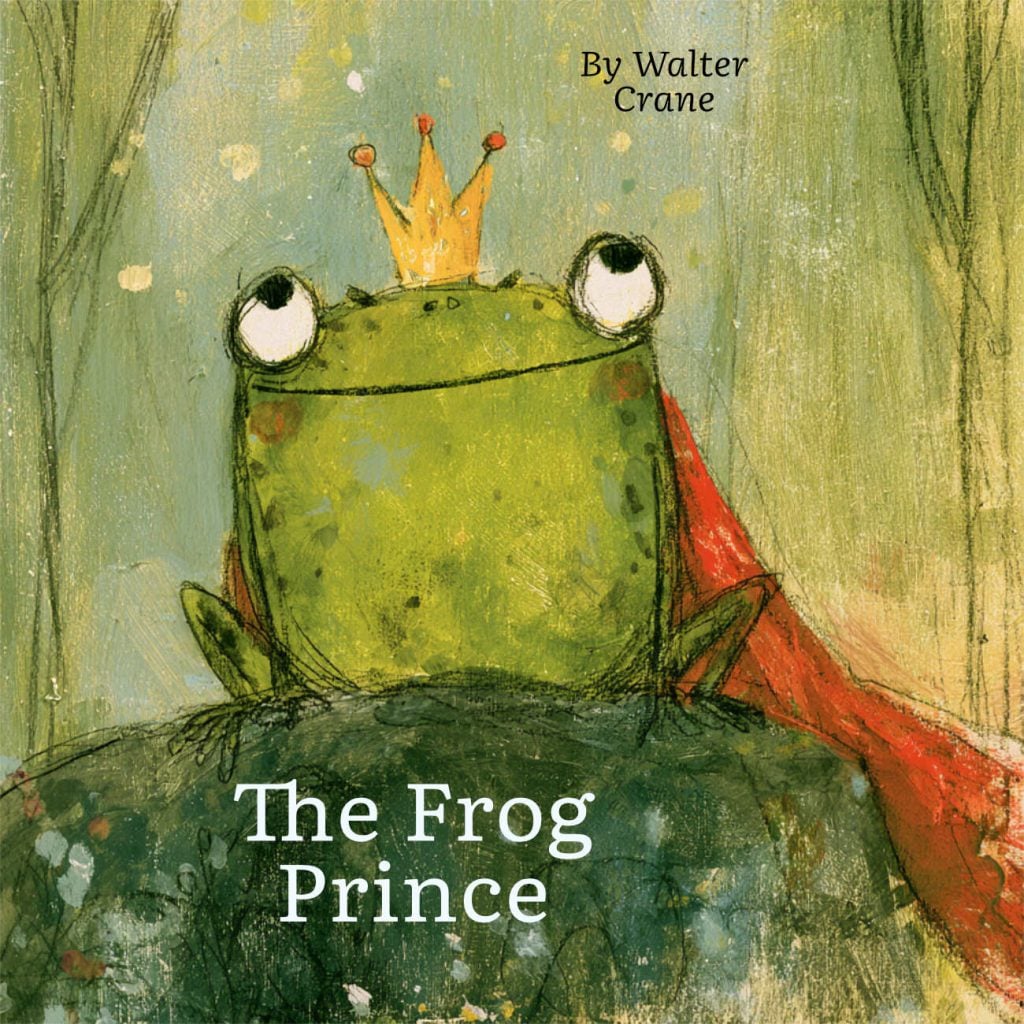
The Frog Prince
When a Princess loses her precious golden ball in a deep fountain, a Frog agrees to retrieve it in exchange for her promise that he may become her companion. The Princess quickly forgets her promise — but when the Frog arrives at the palace to collect what she offered, she discovers that he is not quite what he seems.
Listen to the audiobook
Read ‘The Frog Prince’ online for free
In the olden time, when wishing was having, there lived a King whose daughters were all beautiful; but the youngest was so exceedingly beautiful that the Sun himself, although he saw her very often, was enchanted every time she came out into the sunshine.
Near the castle of this King was a large and gloomy forest, and in the midst stood an old lime-tree, beneath whose branches splashed a little fountain; so, whenever it was very hot, the King’s youngest daughter ran off into this wood, and sat down by the side of this fountain; and, when she felt dull, would often divert herself by throwing a golden ball up in the air and catching it. And this was her favourite amusement.
Now, one day it happened that this golden ball, when the King’s daughter threw it into the air, did not fall down into her hand, but on the grass; and then it rolled past her into the fountain. The King’s daughter followed the ball with her eyes, but it disappeared beneath the water, which was so deep that no one could see to the bottom. Then she began to lament, and to cry louder and louder; and, as she cried, a voice called out, “Why do you weep, O King’s daughter? your tears would melt even a stone to pity.” And she looked around to the spot whence the voice came, and saw a Frog stretching his thick ugly head out of the water. “Ah! you old water-paddler,” said she, “was it you that spoke? I am weeping for my golden ball, which has slipped away from me into the water.”

“Be quiet, and do not cry,” answered the Frog; “I can give you good advice. But what will you give me if I fetch your plaything up again?”
“What will you have, dear Frog?” said she. “My dresses, my pearls and jewels, or the golden crown which I wear?”
The Frog answered, “Dresses, or jewels, or golden crowns, are not for me; but if you will love me, and let me be your companion and playfellow, and sit at your table, and eat from your little golden plate, and drink out of your cup, and sleep in your little bed,—if you will promise me all these, then will I dive down and fetch up your golden ball.”
“Oh, I will promise you all,” said she, “if you will only get me my ball.” But she thought to herself, “What is the silly Frog chattering about? Let him remain in the water with his equals; he cannot mix in society.”
But the Frog, as soon as he had received her promise, drew his head under the water and dived down. Presently he swam up again with the ball in his mouth, and threw it on the grass. The King’s daughter was full of joy when she again saw her beautiful plaything; and, taking it up, she ran off immediately.
“Stop! stop!” cried the Frog; “take me with you. I cannot run as you can.” But all his croaking was useless; although it was loud enough, the King’s daughter did not hear it, but, hastening home, soon forgot the poor Frog, who was obliged to leap back into the fountain.
The next day, when the King’s daughter was sitting at table with her father and all his courtiers, and was eating from her own little golden plate, something was heard coming up the marble stairs, splish-splash, splish-splash; and when it arrived at the top, it knocked at the door, and a voice said, “Open the door, youngest daughter of the King!”

So she rose and went to see who it was that called her; but when she opened the door and caught sight of the Frog, she shut it again with great vehemence, and sat down at the table, looking very pale. But the King perceived that her heart was beating violently, and asked her whether it were a giant who had come to fetch her away who stood at the door.
“Oh, no!” answered she; “it is no giant, but an ugly Frog.”
“What does the Frog want with you?” said the King.
“Oh, dear father, when I was sitting yesterday playing by the fountain, my golden ball fell into the water, and this Frog fetched it up again because I cried so much: but first, I must tell you, he pressed me so much, that I promised him he should be my companion. I never thought that he could come out of the water, but somehow he has jumped out, and now he wants to come in here.”
At that moment there was another knock, and a voice said,—
“King’s daughter, youngest,
Open the door.
Have you forgotten
Your promises made
At the fountain so clear
‘Neath the lime-tree’s shade?
King’s daughter, youngest,
Open the door.”
Then the King said, “What you have promised, that you must perform; go and let him in.”
So the King’s daughter went and opened the door, and the Frog hopped in after her right up to her chair: and as soon as she was seated, the Frog said, “Take me up;” but she hesitated so long that at last the King ordered her to obey. And as soon as the Frog sat on the chair, he jumped on to the table, and said, “Now push your plate near me, that we may eat together.” And she did so, but as everyone saw, very unwillingly. The Frog seemed to relish his dinner much, but every bit that the King’s daughter ate nearly choked her, till at last the Frog said, “I have satisfied my hunger and feel very tired; will you carry me upstairs now into your chamber, and make your bed ready that we may sleep together?” At this speech the King’s daughter began to cry, for she was afraid of the cold Frog, and dared not touch him; and besides, he actually wanted to sleep in her own beautiful, clean bed.

But her tears only made the King very angry, and he said,” He who helped you in the time of your trouble, must not now be despised!” So she took the Frog up with two fingers, and put him in a corner of her chamber. But as she lay in her bed, he crept up to it, and said, “I am so very tired that I shall sleep well; do take me up or I will tell your father.” This speech put the King’s daughter in a terrible passion, and catching the Frog up, she threw him with all her strength against the wall, saying, “Now, will you be quiet, you ugly Frog?”
But as he fell he was changed from a frog into a handsome Prince with beautiful eyes, who, after a little while became, with her father’s consent, her dear companion and betrothed. Then he told her how he had been transformed by an evil witch, and that no one but herself could have had the power to take him out of the fountain; and that on the morrow they would go together into his own kingdom.

The next morning, as soon as the sun rose, a carriage drawn by eight white horses, with ostrich feathers on their heads and golden bridles, drove up to the door of the palace, and behind the carriage stood the trusty Henry, the servant of the young Prince. When his master was changed into a frog, trusty Henry had grieved so much that he had bound three iron bands round his heart, for fear it should break with grief and sorrow. But now that the carriage was ready to carry the young Prince to his own country, the faithful Henry helped in the bride and bridegroom, and placed himself in the seat behind, full of joy at his master’s release. They had not proceeded far when the Prince heard a crack as if something had broken behind the carriage; so he put his head out of the window and asked Henry what was broken, and Henry answered, “It was not the carriage, my master, but a band which I bound round my heart when it was in such grief because you were changed into a frog.”

Twice afterwards on the journey there was the same noise, and each time the Prince thought that it was some part of the carriage that had given way; but it was only the breaking of the bands which bound the heart of the trusty Henry, who was thenceforward free and happy.
Are you seeking more stories on this theme? Read our review of the Ten Best Children’s Books About Feelings and Emotions
Short story by Walter Crane
Let’s talk about ‘The Frog Prince’!
The Frog Prince raises complicated questions about promises, feelings and personal boundaries. These questions can help children think about both treating others fairly and speaking up when something makes them uncomfortable.
Responsibility
- The Princess promises the Frog that he can become her companion if he retrieves her golden ball. Why does making a promise create a responsibility?
- The Princess never really intends to keep her promise. What could she have done differently before agreeing to the Frog’s conditions?
- If we realise that we have made a promise we should not have made, what is a responsible way to deal with it?
Empathy
- The Princess repeatedly calls the Frog ugly and treats him as though his feelings do not matter. How might the Frog feel?
- Why can it be hurtful to decide what someone is like based only on their appearance?
- Can we care about another person’s feelings while still saying no to something that makes us uncomfortable?
Stranger Danger
- The Frog helps the Princess, but she knows very little about him. Does receiving help from someone mean that you owe them friendship, affection or physical closeness?
- If someone offers to help you only if you agree to something that makes you uncomfortable, what could you do instead?
- The King is a trusted adult, but the Princess is still frightened. If a trusted adult tells a child to do something that feels unsafe or deeply uncomfortable, what other trusted person could the child talk to?
Feelings
- When the Frog asks to sleep in the Princess’s bed, she becomes frightened and begins to cry. What feelings might she be experiencing besides anger?
- How could the Princess explain to her father that she wants to keep her word in some ways, but feels uncomfortable with the Frog sharing her bed?
- If someone feels upset or uncomfortable, is it possible to express those feelings firmly without insulting or hurting another person? What might the Princess have said?
Promises
- The Princess promises the Frog something even though she privately intends to run away. Why is making a promise you do not intend to keep unfair?
- Does keeping a promise mean that you must continue with every part of it even if you later feel unsafe or uncomfortable? What could you do instead?
- How could the Princess and the Frog have made a clearer and fairer agreement before he retrieved the golden ball?
Vocabulary
- Lime-tree
- A large leafy tree also known as a linden tree.
- Lament
- To express sadness or grief, often by crying or speaking sorrowfully.
- Playfellow
- An old-fashioned word for a friend or companion who plays with you.
- Courtiers
- People who attend or serve a king, queen or royal family.
- Vehemence
- Great force, intensity or strong emotion.
- Betrothed
- Engaged or promised in marriage.
- Bridle
- Part of the equipment placed around a horse’s head to help guide it.
- Thenceforward
- From that time onward.
Context
The Frog Prince is a traditional European fairy tale closely associated with the Brothers Grimm and classified as ATU 440. The Storyberries version is credited to Walter Crane, who published an illustrated retelling titled The Frog Prince in 1874. Its central motifs — the golden ball, the fountain, a promise to a frog, the royal dinner, the enchanted Prince and Trusty Henry’s iron-bound heart — connect it closely with the Grimm tale often called The Frog King, or Iron Henry.
This version is notably different from many modern retellings. The Princess does not kiss the Frog. Instead, after becoming angry with him, she throws him against the wall and the enchantment is broken. The story therefore provides an especially useful opportunity to compare older fairy tales with later adaptations.
The tale also contains a genuine tension between two ideas. The Princess knowingly makes a promise she does not intend to keep, which raises questions about honesty and responsibility. At the same time, she becomes visibly frightened when the Frog demands increasing physical closeness, including sharing her bed. Modern discussions of the story can therefore distinguish between treating others fairly and respecting promises on the one hand, and recognising personal boundaries and the right to speak up about unwanted physical closeness on the other. A promise should not be used to silence someone who feels unsafe or uncomfortable.
FAQs about ‘The Frog Prince’
What is The Frog Prince about?
The Frog Prince tells the story of a Princess whose golden ball falls into a deep fountain. A Frog retrieves it after she promises to let him become her companion, eat from her plate and sleep in her room. She immediately runs away and tries to forget her promise, but the Frog follows her to the palace. Eventually the enchantment on him is broken and he is revealed to be a Prince.
Who wrote this version of The Frog Prince?
The Storyberries page credits this version to Walter Crane, who also created its illustrations. Crane published an illustrated Frog Prince in 1874 as part of The Frog Prince and Other Stories. The underlying fairy tale is much older and is closely associated with the Brothers Grimm tradition. A digitised version of Crane’s 1874 text is available through Project Gutenberg.
Is The Frog Prince a Brothers Grimm fairy tale?
The best-known traditional version is closely associated with Jacob and Wilhelm Grimm and is often titled The Frog King, or Iron Henry. Storyberries currently includes this Walter Crane retelling in its Brothers Grimm Fairy Tales collection. Walter Crane’s version follows the familiar Grimm-linked story structure while presenting the tale in his own nineteenth-century edition.
Does the Princess kiss the Frog Prince in the original story?
Not in this version. The Princess becomes furious when the Frog insists on sharing her bed and throws him against the wall. He then transforms into a handsome Prince. The famous kiss is a feature of many later retellings rather than the transformation shown in Walter Crane’s version.
Why does the Frog make the Princess promise to let him live with her?
The Frog is not interested in the Princess’s dresses, jewels or crown. Instead, he asks to become her companion and share her everyday life. The bargain creates the central conflict because the Princess readily agrees when she wants her ball back but has no intention of keeping her word. The story therefore raises questions about responsibility and making promises seriously.
Why does the King insist that the Princess keep her promise?
The King believes that someone who helped his daughter in a time of trouble should not be rejected once she has received what she wanted. His response reinforces the traditional moral that promises should be honoured and help should be repaid. Modern readers can also use the scene to discuss how responsibility and personal boundaries can sometimes come into tension. If a promise makes someone feel unsafe or deeply uncomfortable, talking to a trusted adult is important.
Does the Princess have to keep every part of her promise to the Frog?
The traditional story presents keeping one’s promise as an important moral duty, particularly because the Princess knowingly agrees to the Frog’s conditions and intends to deceive him. However, a modern discussion can distinguish between keeping a fair commitment and agreeing to unwanted physical closeness. Sharing a bed, being touched or allowing someone into a private space involves personal boundaries, and someone should be able to say that they are uncomfortable even if they previously agreed. The more responsible response would be to explain the change honestly, seek help and negotiate a safer alternative rather than simply disappearing or insulting the other person.
What can The Frog Prince teach children about personal boundaries?
The story provides a useful example of why kindness and boundaries can exist at the same time. The Princess can acknowledge that the Frog helped her and treat him respectfully without being required to feel comfortable with every form of closeness he requests. Children can discuss that accepting help does not mean owing someone affection, touch or access to private spaces. If something feels unsafe or uncomfortable, they can say so clearly and seek help from another trusted adult.
Why does the Frog turn into a Prince?
The Frog explains that an evil witch transformed him and that the Princess was the person able to free him from the enchantment. When she throws him against the wall, his frog form disappears and he becomes a Prince again. Unlike many modern versions, the spell is not broken by a kiss. This striking difference shows how fairy tales often change considerably between versions.
Who is Trusty Henry in The Frog Prince?
Trusty Henry is the Prince’s faithful servant. When the Prince was transformed into a Frog, Henry was so grief-stricken that he placed three iron bands around his heart because he feared it would break from sorrow. During the journey home, the bands crack one after another as Henry’s grief is replaced by happiness. This is why the Grimm tale is sometimes called The Frog King, or Iron Henry.
What is the main lesson of The Frog Prince?
One important lesson concerns keeping promises and accepting responsibility for what we say. The story also challenges the Princess’s tendency to judge the Frog entirely by his appearance and social status. At the same time, modern readers can discuss the importance of communicating feelings and maintaining personal boundaries when a request becomes uncomfortable. Different readers may therefore find different lessons about responsibility, empathy, feelings, promises and respect.
How can teachers use The Frog Prince in class?
The story works well for sequencing, comparing fairy-tale versions and analysing character motivation. Students might trace the Princess’s changing feelings toward the Frog or compare the Walter Crane version with a modern retelling in which a kiss breaks the spell. Teachers can also explore promises, stranger safety, personal boundaries, empathy and the symbolic iron bands around Trusty Henry’s heart. These activities support comprehension, discussion and social-emotional learning.
What is the Aarne–Thompson–Uther classification of The Frog Prince?
The Frog Prince family of stories is classified as ATU 440, commonly known as “The Frog King” or the tale of the supernatural frog bridegroom. D. L. Ashliman’s Frog Kings collection brings together ATU 440 variants from Germany, Denmark, Hungary, Ireland, Scotland, England, Korea and other traditions. It also includes several different English and Grimm versions of The Frog Prince.
What age is The Frog Prince suitable for?
Storyberries currently places this version in the 7–12 years age range and the 10 Min Stories collection. The language is older than many modern retellings, and the Princess violently throws the Frog against a wall before his transformation. It also contains useful but complicated questions about promises, personal boundaries and unwanted closeness. These elements make the vintage version particularly suitable for shared reading and discussion.
Credits
- Short story by: Walter Crane
- Illustrations by: Walter Crane
- Audiobook read by: Jade Maitre