
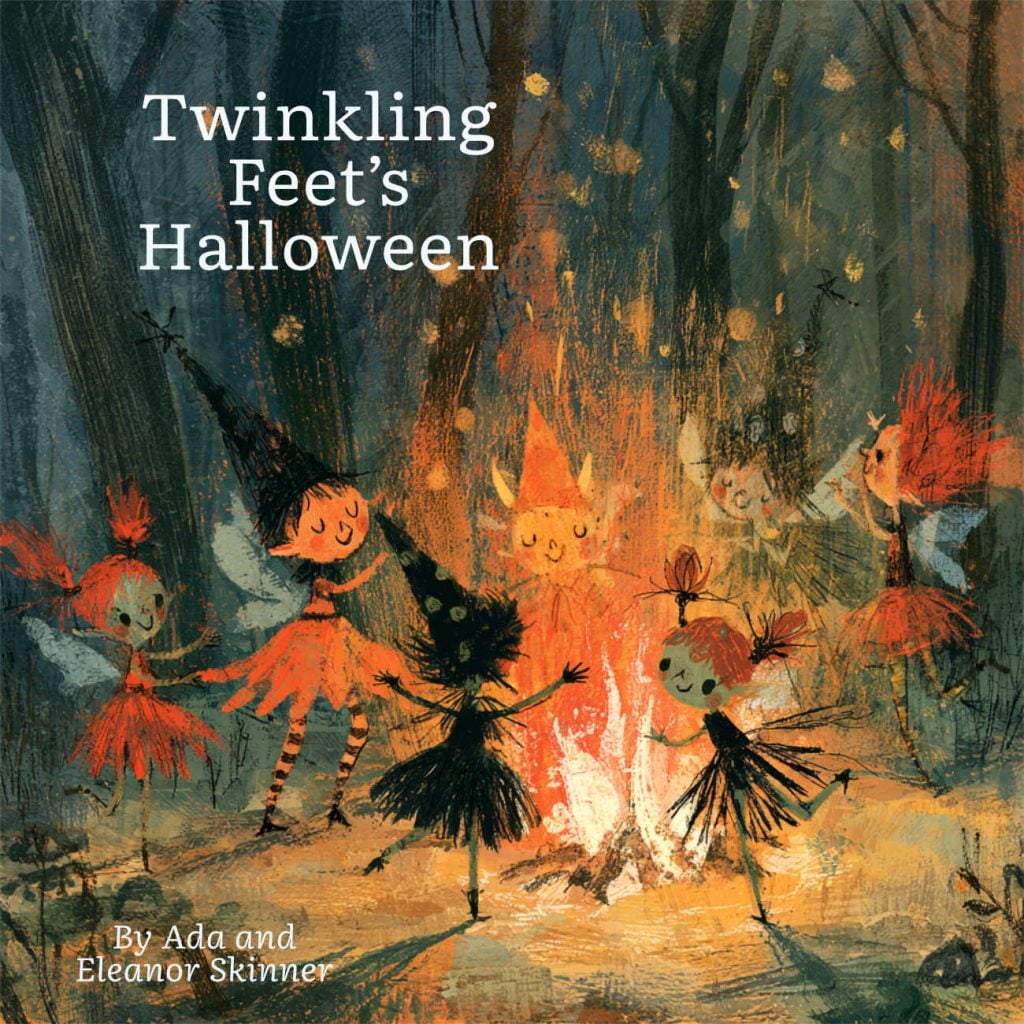
Twinkling Feet’s Halloween
When a mischievous pixie trips the dancers at a Halloween celebration, he suddenly loses his laugh. With midnight approaching, Twinkling Feet searches for it, meeting Jack-o’-Lantern and a Jolly Little Witch along the way. This fairy tale adapted from a Cornish legend explores mischief, helping others and how laughter returns.
Listen
Enjoy the audiobook and let the narration spark imagination.
Read
Read the story at your own pace.
One Hallowe’en a band of merry pixies were dancing round and round a bright green ring in the meadow. In the center stood the Little Fiddler, playing his gayest music, and keeping time with his head and one tiny foot. The faster he played, the merrier the little creatures danced. What sport it was to twirl and twist in time with the fairy music, which the jolly little elf brought out from his tiny instrument. No wonder the pixies laughed until their sides ached. And so, indeed, did their little musician. Sometimes he was obliged to stop playing for a few seconds in order to catch his breath.
Now there was one pixie named Twinkling Feet who was the best dancer in the ring, and he could cut such queer little capers that his companions fairly shrieked with laughter when they looked at him. Suddenly he thought what sport it would be to play a trick on all the little dancers. Very slyly he tripped his partner, and the two fell down in the grass, dragging with them one pixie after another until all in the circle were sprawling on the ground. There they lay for several seconds, a wriggling mass of green coats and red caps. It was some time before they could pick themselves up. Many of them laughed heartily at the mishap, but a few were so badly bruised that they were obliged to slip away and bathe their shins in the evening dew.
“Who tripped first in the ring?”
“Who made us fall on our stumjackets?”
“Who spoiled our Hallowe’en dance?” asked one little pixie after another.
“Twinkling Feet and I fell first,” said the best dancer’s partner. “I don’t know what made us tangle our feet, do you?” he asked, laughing and turning to his companion.
But Twinkling Feet’s little brown face was so drawn and sober that his partner asked quickly, “Why, what is the matter with you?”
“I don’t know,” said the little elf.
“Why, do look at him,” cried another pixie.
“Does anything hurt you?” asked several little creatures together.
“I feel very queer,” said Twinkling Feet.
“Have you what mortals call ‘pain?’” asked his partner.
“I don’t know what that is, but I feel very, very queer. Please ask the Little Fiddler if he knows what is the matter with me.”
The group of pixies that had gathered around Twinkling Feet moved away in order to let the elfin musician come close to the queer-looking pixie. The little Fiddler gazed steadily at him, shook his white head, and said slowly, “A frightful thing has happened. Twinkling Feet has lost his laugh!”
“Lost his laugh!” shrieked all the other little elves.
“He has lost his laugh!” repeated the Fiddler Pixie.
“Lost my laugh,” moaned Twinkling Feet. “Oh, please tell me what to do.”
“There is nothing to do but go and search for it. You can not dance in a pixie ring without your laugh, and mark what I say, you must find it before midnight.”
“But what if I can’t find it?” cried the frightened elf.
“Then you’ll be a pixie without a laugh—that is all,” declared the Little Fiddler.
At these awful words every pixie’s face grew sober. They looked at each other very solemnly and said, “A pixie without a laugh! How terrible!”
Then one after another they cried out. “Search for it, Twinkling Feet. Perhaps you’ll find it before midnight. Start now. Think how sad it will be if you are never able to dance in the ring again.”
“Where shall I go, Fiddler Pixie?” asked Twinkling Feet.
“Well, you might ask Jack-o’-Lantern,” said the musician. “He’s been flitting about in the meadow all the evening. See, there he goes over by the brook.”
Away ran the little pixie as fast as his legs could carry him. It was no easy matter to come close enough to Jack-o’-Lantern to make him hear. Twinkling Feet was almost ready to give up the chase when the little man stopped, poked his head out of his lantern, and called, “Do you wish to speak to me?”
“Don’t you know me?” cried the pixie. “I’m Twinkling Feet.”
“Why, what has happened to you?” asked Jack. “You’re the queerest looking chap I ever saw.”
“I’ve lost my laugh. Please tell me, Jack-o’-Lantern, have you seen it?”
“Lost your laugh!” repeated the lantern man, looking very serious. “No wonder I didn’t know you. I’m very sorry to say I’ve seen nothing of your laugh.”
“Do you know anyone who could help me, Jack?” asked Twinkling Feet. “Oh do help me find it.”
“Well, let me see. You might ask Jolly Little Witch. Her eyes are very sharp. She’s in the ragweed meadow, looking for a good riding stalk. As soon as she finds one I’m going to light her to the village where she will make plenty of merriment at the children’s party. It’s Hallowe’en, you know. Come, jump into my lantern, and I’ll take you to her.”
Twinkling Feet hopped into the little lantern, and away they went to the ragweed field. When they drew near the Jolly Little Witch called out, “I’ve found a good ragweed stalk, Jack, but I’ve lost my goggles. Come, perhaps you can help me find them. I can’t go to the village without my goggles. Why, who is that in the lantern with you?”
“A pixie who wants to ask you something,” said Jack-o’-Lantern, opening the door to let Twinkling Feet out. Then the lantern man hurried away to search for the witch’s goggles.
“Please, Jolly Little Witch, I’ve lost my laugh,” said Twinkling Feet.
“Lost your laugh! and on Hallowe’en! Well, no wonder I didn’t know you. You’re the queerest looking pixie I ever saw. Tell me how you happened to lose your laugh?”
But Twinkling Feet did not answer her question. He said meekly, “Have you seen it?”
“No, my little fellow. I’m sorry to say I’ve not seen your laugh,” said the Jolly Little Witch.
“A pixie can’t dance without his laugh,” sighed Twinkling Feet.
“No, of course he can’t. Dear, dear! How sorry I am for you,” said the little witch, shaking her head.
“And if a pixie loses anything on Hallowe’en, he must find it before midnight or give it up forever.”
“I could have helped you on any other night, but you see I always spend Hallowe’en in the village with the children. I shall be late to-night if I don’t find those goggles.” And again she began to search for them.
The pixie looked at her for a moment. Then he asked, “Do the children laugh a good deal on Hallowe’en?”
“Why, my little man, it’s the time in all the year when they laugh most. To-night there is to be a witch’s party. I shall secretly join the children, and play all sorts of tricks for their amusement. What a nuisance it is that I’ve lost those goggles.”
“I’ll help you search for them, Jolly Little Witch,” said the pixie. “I suppose I must give up my laugh, for I don’t know anyone else to ask about it. Please tell me what your goggles look like.”
“They are two round glass windows, which I wear over my eyes when I ride through the air,” said the little Witch.
Away started the pixie to search for them. He looked carefully around every ragweed stalk in the meadow, but he could see nothing which looked like “two round glass windows.”
“Perhaps one cannot find anything which has been lost on Hallowe’en,” he said to himself.
Slowly he walked back to the place where he had left the Jolly Little Witch. When he reached her he stared sharply at something on top of her head.
“Please tell me more about your goggles,” said Twinkling Feet. “Are they like the two glass windows across the front of your hat?”
“Across the front of my hat!” exclaimed the witch, putting her hands up to find out what the little elf meant. Then she burst out laughing, and said, “Well, well! What strange things do happen on Hallowe’en! Come, Jack-o’-Lantern! Come! The pixie has found my goggles. They were on top of my head all the time!”
And turning to Twinkling Feet she said, “You shall go with us to the village, and see the merriment if you like. I’m sure Jack will carry you in his lantern.”
“Of course I will,” said the lantern man. “And while you are playing tricks at the children’s party, I’ll carry him anywhere he wishes to go. It is a long while before midnight.”
“I want to see the children, and hear them laugh,” said Twinkling Feet.
The Jolly Little Witch pulled her goggles down on her nose, and mounted her ragweed stalk. The pixie hopped into the lantern, and away through the air the three sailed.
When they drew near the village, the little Witch lowered herself to the ground.
“Meet me here before the party is over, Jack-o’-Lantern,” she said. “I shall leave before the children take off their masks. In the meantime, let Twinkling Feet see the fun the children will have on the way to the party.”
Away she ran up the village street to a corner where she joined a group of jolly little boys and girls on their way to the party. They wore black dresses, high, pointed hats with narrow brims, and funny little masks. Not a word did anyone speak, but the sound of their merry laughter reached Twinkling Feet’s ears.
He slipped out of the lantern, and ran toward the group of children as fast as he could go. Before he reached them, however, the tiniest bit of a creature, turning somersaults faster than anyone could count, came bounding to him. It climbed up the pixie’s little body, and disappeared into his mouth. Twinkling Feet burst into the merriest laugh, and ran back to Jack-o’-Lantern, crying out, “I’ve found it! I’ve found my laugh! My dear little laugh! Oh, how happy I am! Jack-o’-Lantern, please take me back to the pixie ring. I’ve found my dear little laugh!”
He hopped into the little man’s lantern, and away over the fields they flew. As they drew near the green ring where the pixies were still dancing, the delighted elf called out, “I’ve found my laugh! I’ve found my dear little laugh!”
“Welcome back, Twinkling Feet,” answered the dancers.
He hopped out of the lantern, and joined the other merry pixies. When they stopped dancing for a little while, the Fiddler Pixie slipped up to the Twinkling Feet, and whispered slyly, “Always watch your laugh carefully while you are dancing.”
Copyright © Storyberries
Explore the story
Context
Explore the ideas, feelings and learning behind the story.
Storyberries presents Twinkling Feet’s Halloween as a fairy tale adapted from a Cornish legend by Ada M. Skinner and Eleanor L. Skinner. Its pixie ring, fiddle music, Jack-o’-Lantern and flying witch belong to a playful imaginary world in which laughter can quite literally go missing.
The story begins with a prank that sends the dancers tumbling. Twinkling Feet’s search brings him to other characters who need help, especially the witch who has misplaced her goggles. The midnight deadline provides suspense without turning the tale into a frightening Halloween story.
Readers can compare the consequences of the prank with the more considerate acts that follow, while also exploring expressive older words such as “capers”, “flitting” and “merriment”. A useful takeaway is to think about how jokes affect others and how helping someone can change a difficult situation.
Vocabulary
Discover useful new words and what they mean.
- Capers
- Playful jumps, dances or funny movements.
- Shrieked
- Cried out in a very high, loud voice.
- Sprawling
- Lying or stretching with arms and legs spread out.
- Solemnly
- In a serious and thoughtful way.
- Flitting
- Moving lightly and quickly from one place to another.
- Ragweed
- A kind of wild plant growing in the meadow.
- Meekly
- In a quiet or gentle way, without acting boldly.
- Goggles
- Glasses worn to help protect someone’s eyes.
- Merriment
- Cheerful fun, laughter and celebration.
Discussion questions
Use the story to spark thoughtful, imaginative conversations.
Co-operation
- How does Jack-o’-Lantern make Twinkling Feet’s search easier?
- What changes when Twinkling Feet offers to help the witch find her goggles?
- Which part of the adventure might have been harder if everybody had tried to solve their problems alone?
Feelings
- How might the pixies who fell have felt about Twinkling Feet’s trick?
- What clues show that Twinkling Feet feels different when his laugh disappears?
- How does hearing the children laugh change Twinkling Feet’s mood?
Responsibility
- What could Twinkling Feet have done differently before tripping his partner?
- How could Twinkling Feet make things right with the pixies who were hurt?
- Why is it important to think about the result of a joke before playing it?
Kindness
- Why does Twinkling Feet help the witch even though he has a problem of his own?
- How do the witch and Jack-o’-Lantern show care for Twinkling Feet?
- What small act of kindness could you do for someone having a disappointing day?
Frequently Asked Questions
Helpful answers for parents and teachers.
What happens in Twinkling Feet’s Halloween?
Twinkling Feet is a gifted pixie dancer who secretly trips his partner during a Halloween dance, causing the whole circle to tumble. Soon afterwards, he discovers that his laugh has vanished. He follows Jack-o’-Lantern to a little witch, helps her with a problem and eventually regains his laugh when he hears children enjoying their Halloween celebration.
Why does Twinkling Feet lose his laugh?
His laugh disappears immediately after he plays a trick that sends the other pixies sprawling; some are even bruised. The story never explains the exact magic behind the loss, so it is more accurate to discuss the sequence than to call it an explicit punishment. Ask children how an amusing prank can feel different to the person on the receiving end.
Why does Twinkling Feet have to find his laugh before midnight?
The Little Fiddler warns Twinkling Feet that he must recover his laugh before midnight or remain a pixie without one. The little witch later repeats the Halloween rule about losing things. The deadline gives the search urgency and is part of the tale’s fairy-world logic, not a real Halloween custom. Children can notice how a time limit builds suspense.
How does Jack-o’-Lantern help Twinkling Feet?
Jack-o’-Lantern is unable to find the missing laugh himself, but he listens carefully and takes the pixie in his lantern to the Jolly Little Witch. Later, he offers to carry Twinkling Feet around the village and back to the dancing ring. His help matters because he provides transport and encouragement rather than pretending to have an answer he does not know.
Why does Twinkling Feet help the little witch find her goggles?
The witch is worried that she will miss the children’s Halloween party because she cannot find her flying goggles. Although Twinkling Feet is anxious about his own lost laugh, he helps search and notices that the goggles have been on her head all along. The scene gives children a concrete example of co-operation between characters with different problems.
How does Twinkling Feet finally get his laugh back?
When Twinkling Feet hears children laughing on their way to the party, a tiny tumbling creature bounds towards him, climbs up his body and vanishes into his mouth. He immediately laughs again and asks Jack-o’-Lantern to take him home. The episode is deliberately magical: the text presents the returning laugh as a little creature rather than giving a realistic explanation.
What does the story suggest about jokes and responsibility?
Twinkling Feet begins by making everyone fall for his own amusement, and the story specifically mentions pixies who are hurt. Although he never gives a spoken apology, his later choice to help the witch creates a useful contrast between selfish mischief and consideration for others. Ask children to imagine what he could say to his partner after returning to the ring.
Is this Halloween story suitable for children who dislike scary tales?
The story has a midnight deadline, a witch, and a worried pixie, but it does not contain frightening monsters or graphic violence. Its main tension is whether Twinkling Feet can recover his laugh in time. Some children may still dislike the moment when the dancers are hurt. Adults can preview the tale and browse other Halloween stories for kids to choose a suitable mood.
How can teachers use the old-fashioned vocabulary in this fairy tale?
The story contains vivid words such as “capers”, “flitting”, “meekly” and “merriment”, alongside older spellings including “Hallowe’en” and “to-night”. Read a short passage aloud and ask pupils to infer meanings from the surrounding actions before checking them. For additional reading, the Fairy Tales collection offers more narrative language to compare.
Who adapted Twinkling Feet’s Halloween, and is it a Cornish legend?
The published Storyberries text credits Ada M. Skinner and Eleanor L. Skinner and describes the tale as adapted from a Cornish legend. That attribution does not establish a particular historical recording or an ATU tale-type number, so neither should be assumed. Teachers can introduce it as a credited folklore adaptation and visit the adaptors’ Storyberries archive for author-related material.
Credits
Meet the people who brought Twinkling Feet’s Halloween to life.
Adapted from a Cornish legend by Ada M. Skinner and Eleanor L. Skinner.
Audiobook narration by Jade Maitre.

Copyright © Storyberries