
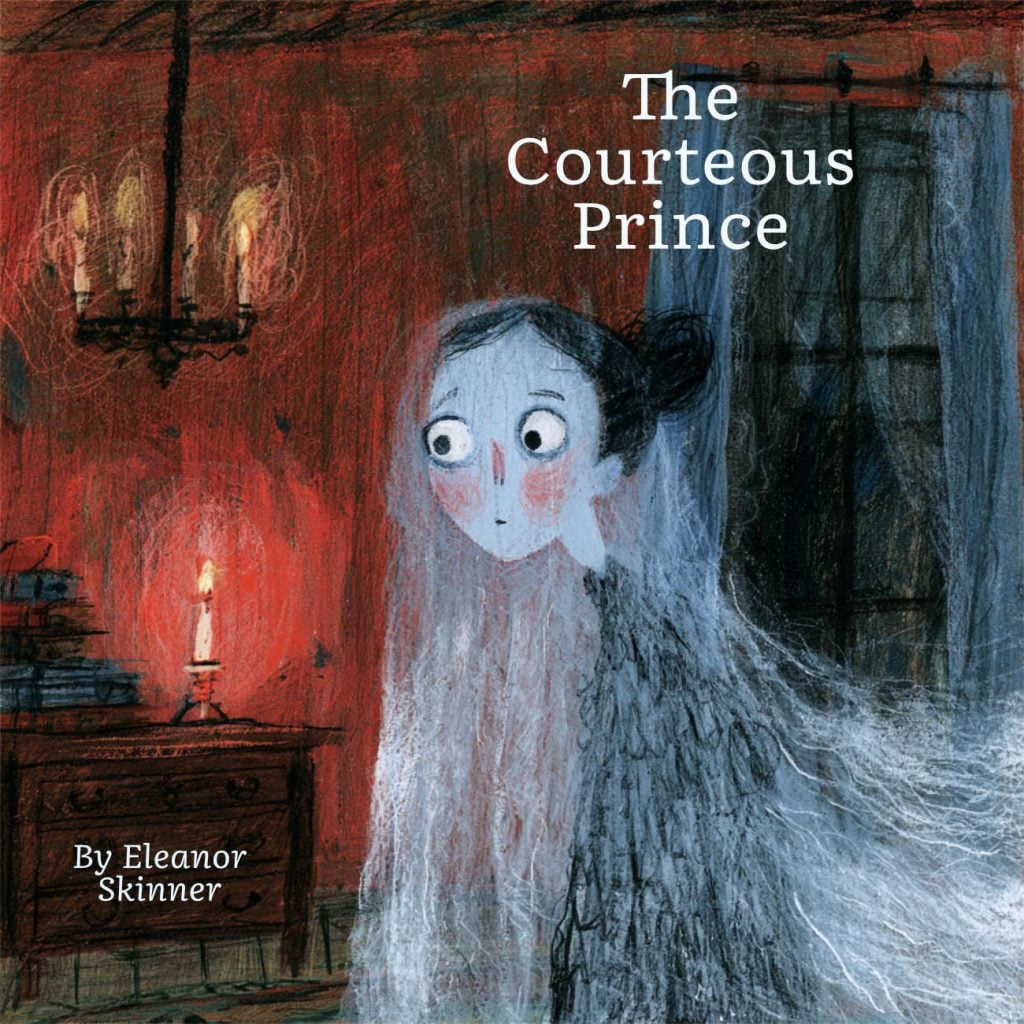
The Courteous Prince
When a young prince loses his sweetheart to a witch’s spell, a Halloween hunt leads him to a deserted hall and a frightening visitor. To escape the witch’s enchantment, he must show kindness even when he feels afraid. Read this atmospheric fairy tale about courage, love and the unexpected power of courtesy.
Listen
Enjoy the audiobook and let the narration spark imagination.
Read
Read the story at your own pace.
Once upon a time a bonnie Prince fell in love with a lassie who was nobly born, but was not his equal in rank. The king was sorely vexed, because his son looked with favour on this maiden, and his majesty determined to part the lovers. He sent the high chancellor of the court to an old witch for advice. After thinking the matter over for nine days, the old woman muttered the following answer:
“The lassie will I charm away
’Till courtesy doth win the day.”
“I’m not quite sure what the old hag means,” said the king. “But if she’ll get this maiden out of the Prince’s sight, I can arrange for his marriage with some one of his own rank.”
In a few days the lassie disappeared, and the Prince could find no trace of her. He was very sad, indeed, and declared if he could not marry his own true love he would remain single all his life.
It happened one fine day near the end of October that the young Prince and a party of nobles went hunting. The hounds were soon on the track of a fine deer, which was so wily and fleet of foot that the nobles, one by one, lost track of the quarry, and dropped out of the chase. The young Prince, who was a famous rider, continued the hunt alone. Miles and miles over the low hills he galloped until at last in the depths of a wooded glen the exhausted deer was brought to bay by the hounds, and dispatched by the Prince.
Not until after the prize was won did the royal hunter realize how dusky it was in the glen, and how threatening the evening sky looked. He felt sure he was too far from the palace to retrace his journey; besides, he had lost all trace of direction. He threw the quarry over his steed’s back, whistled to his hounds, and rode slowly down the wooded valley, wondering where he could lodge for the night.
“Little sign of hospitality in this lonely place,” he mused. “Perhaps I’d better make the best of it, and find shelter in one of the rocky hollows.”
On he rode in the gathering darkness. A turn in the valley brought him to a stretch of moorland, and a little distance away he saw the dark outline of an old, deserted hunting hall.
“A cheerless looking inn,” thought the Prince. “No doubt one will have to play host as well as guest here. However, I have my trusty hounds and noble steed for company, and the quarry will furnish a good meal for all of us.”
He leaped from his horse and walked up to the old ruin. With very little effort he broke open the door. The creaking of its rusty hinges made strange echoings throughout the hall. The Prince led his horse into one of the small rooms, then with his hounds he went into the large dining hall, where he lit a fire on the great hearth, and proceeded to cook some venison for supper.
While he was waiting for the meat on the spit to roast, he listened to the rising wind, which moaned about the gloomy old ruin, and rattled the doors and windows unceasingly. The good steed, in the adjoining room, pawed the floor restlessly, and every few moments the hounds stretched their heads straight up into the air, and whined in a most uncanny way.
As he mused before the fire, the Prince thought, “This is All Hallowe’en, the night when ghosts and witches hold their revels. Nevertheless, I’d rather be in this deserted hall than on the storm-swept moorland.”
He took the roasted meat from the fire, and prepared to eat his supper. Suddenly a fierce blast of wind burst open a large door at the far end of the hall, and into the room stalked a tall, ghostly woman. Her lank figure was clothed in grey garments, which trailed for yards on the floor. Her long, grey hair hung loose down her back. By the light of the flickering fire the Prince could see her hollow eyes and wan features. He was a brave man, but this ghostly creature filled him with dread and horror. The hounds dropped their bones of venison, and crept close to their master, who was unable to utter a word.
Slowly down the hall the grey ghost glided to the Prince, and pointing a long, bony finger at him, she asked in a hollow voice, “Art thou a courteous knight?”
In a trembling voice the Prince answered, “I will serve thee. What dost thou wish?”
“Go ye to the moorland, and pluck enough heather to make a bed in the turret-room for me,” said the phantom-like figure.
It was a strange request to make, but the Prince was relieved to have any excuse to get out of her sight. He sprang quickly to his feet, and hurried out to face the stormy night in search of heather. He plucked as much as he could carry in his plaid, and returned to the hall where the ghostly visitor was waiting for him. She led the way down the room, and up a half-ruined staircase to the turret-room. Here the Prince spread a heather bed for her, and covered it with his plaid. When it was finished she pointed to the door, and dismissed him.
“May you sleep well,” said the Prince courteously. Then, cold and weary, he descended to the hall, and lay down to sleep in front of the dying embers of the fire.
When he awakened the bright sun was shining in the windows.
The Prince lost no time in making ready to depart, for he remembered quite well the ghostly visitor of the past night.
“No doubt she departed before the crowing of the cock,” he said. “I wonder if she left my bonnie plaid in the turret room. The autumn air is keen and biting. I’ll go and see.”
He ran quickly up the ruined staircase. To his surprise when he reached the top, the door of the chamber opened, and there before him stood his lost sweetheart.
“How camest thou here?” gasped the Prince. “And where is the grey ghost?”
“Last night I was the grey ghost,” she said.
“And thou wilt change thy form again to-night?” he asked in horror.
“Never again,” said the maiden. “In order to part us a wicked witch threw a spell over me—a spell which changed me into the awful shape thou sawest last night. But thou hast broken her wicked charm.”
“Tell me how,” said the Prince, whose face was beaming with happiness.
“The witch’s charm could not be broken until some knight should serve me, even though my form was horrible. By thy courtesy thou hast broken the spell,” said the maiden.
So the Prince and his true love rode away, and were happily married, and when the king heard of his son’s adventure in the hunting hall he said, “Now I know what that old witch meant by her prophecy.”
Copyright © Storyberries
Explore the story
Context
Explore the ideas, feelings and learning behind the story.
The Courteous Prince is a fairy tale set around All Hallowe’en, with a lonely hunting hall, a fierce storm and an unsettling visitor. The story combines a ghostly encounter with the familiar fairy-tale pattern of a spell that can be broken only when a condition is fulfilled.
The king objects to the prince’s choice of sweetheart because she is of lower rank. The witch’s spell turns the young woman into a frightening figure, while the prince’s willingness to assist her becomes the test. Courtesy here is more than polished speech: he helps a stranger despite his fear and discomfort.
Older language such as “bonnie,” “lassie” and “thou” gives the tale a traditional voice and offers useful opportunities to discuss unfamiliar vocabulary. Children can consider whether treating someone kindly becomes more meaningful when the person seems strange or when helping is difficult.
Vocabulary
Discover useful new words and what they mean.
- Bonnie
- Pretty or attractive; often used in Scottish speech.
- Lassie
- A girl or young woman.
- Vexed
- Upset, annoyed or troubled.
- Chancellor
- A senior official who advises or serves a ruler.
- Courtesy
- Polite, considerate behaviour towards another person.
- Moorland
- Open, often windy country with low-growing plants.
- Heather
- A small flowering plant that commonly grows on moors.
- Plaid
- A length of patterned cloth or woollen wrap, as used by the prince.
- Turret-Room
- A room within a small tower or tower-like part of a building.
- Phantom-Like
- Resembling a ghost or shadowy spirit.
Discussion questions
Use the story to spark thoughtful, imaginative conversations.
Good Manners
- What does the prince do that shows courtesy to the frightening visitor?
- Why does wishing the visitor a good night matter after his hard work?
- Can someone be courteous while feeling afraid or uncomfortable?
Kindness
- Why does the prince carry heather and give up his plaid for the stranger?
- How might the story change if he judged the visitor only by her appearance?
- What is one way to help someone without expecting a reward?
Courage
- Which part of the night seems most frightening to the prince, and why?
- Does courage mean being unafraid, or acting even when you are scared?
- What might you have done when the ghostly woman entered the hall?
Love
- Why does the prince refuse to marry someone chosen for his rank?
- How does the king’s wish to separate the couple lead to the enchantment?
- What do the prince’s actions suggest about how he treats the person he loves?
Frequently Asked Questions
Helpful answers for parents and teachers.
What happens in The Courteous Prince?
A young prince loses his sweetheart after the king asks a witch to separate them. During a Halloween hunt, he becomes lost and shelters in an abandoned hall. A terrifying woman asks him to prepare her a bed of heather. He obeys and treats her respectfully. In the morning she is revealed as his lost love, freed from the witch’s spell.
Why does the witch transform the maiden?
The king dislikes the match because the maiden is nobly born but not of equal royal rank. He asks his chancellor to consult a witch about separating the couple, and she enchants the young woman. This makes the story a useful starting point for discussing the difference between social position and a person’s actual worth. The maiden has done nothing wrong.
How does the prince break the spell?
He breaks the spell by helping the ghostly woman despite finding her frightening. He gathers heather, makes a bed in the turret-room, lends her his plaid and wishes her a good night. The enchantment can end only when a knight willingly serves the woman in her frightening form. The tale makes courtesy a meaningful action, rather than simply polite words.
Is the grey ghost really a ghost?
No. The woman who appears ghostly is the prince’s missing sweetheart, transformed by a witch’s spell. Her grey clothing, hollow eyes and strange voice are part of the frightening appearance the prince sees. The morning revelation changes how the reader understands the encounter. Ask children which details created suspense and which clues matter once they know the truth.
What does the story suggest about good manners?
The story presents courtesy as consideration for someone who may be unfamiliar, uncomfortable to meet or unable to offer a reward. The prince does not simply speak politely; he goes out into a storm to make his visitor comfortable. Families can compare that choice with everyday acts of kindness. The related Storyberries Good Manners stories offer further discussion.
Why is the story connected with Halloween?
The encounter takes place on All Hallowe’en, which the prince associates with ghosts and witches. The storm, deserted building, strange noises and pale visitor create a suitably eerie atmosphere. Yet the central mystery is resolved through a fairy-tale enchantment rather than an ordinary haunting. For another seasonal selection, browse the Storyberries Halloween stories collection.
Could some parts be too frightening for sensitive readers?
The ghostly woman has hollow eyes and a frightening voice, the hounds whine, and the prince feels intense dread. Earlier, he kills a hunted deer, although the account is not graphic. Children who dislike sinister settings may appreciate a brief introduction or a shared reading. The reassuring ending offers a chance to talk about how fear can change when new information becomes available.
What old-fashioned words could children learn from this fairy tale?
Words including “bonnie,” “lassie,” “plaid” and “moorland” help establish the story’s traditional voice, while “thou,” “thee” and “camest” show older forms of English. These expressions may need explaining during an independent reading. Try finding modern equivalents together without changing the original wording. Children interested in the genre can also browse Storyberries fairy tales.
How can teachers use the story to discuss character choices?
Teachers can compare three decisions: the king asks for the couple to be separated, the prince refuses to abandon his sweetheart, and the prince helps a stranger who scares him. Each choice has a different effect on someone else. Small groups might identify what each character knows at the moment they act. This keeps discussion tied to evidence from the text rather than easy labels.
What could children read after The Courteous Prince?
Children interested in mysterious visitors can explore Storyberries’ ghost stories, while readers intrigued by transformations and spells may enjoy other traditional fairy tales. A useful comparison is whether frightening appearances reveal a character’s true nature. Encourage children to choose one moment in each story when a first impression changes after a character learns more.
Credits
Meet the people who brought The Courteous Prince to life.
Fairy tale written by Eleanor L. Skinner.
Audiobook read by Jade Maitre.

Copyright © Storyberries