
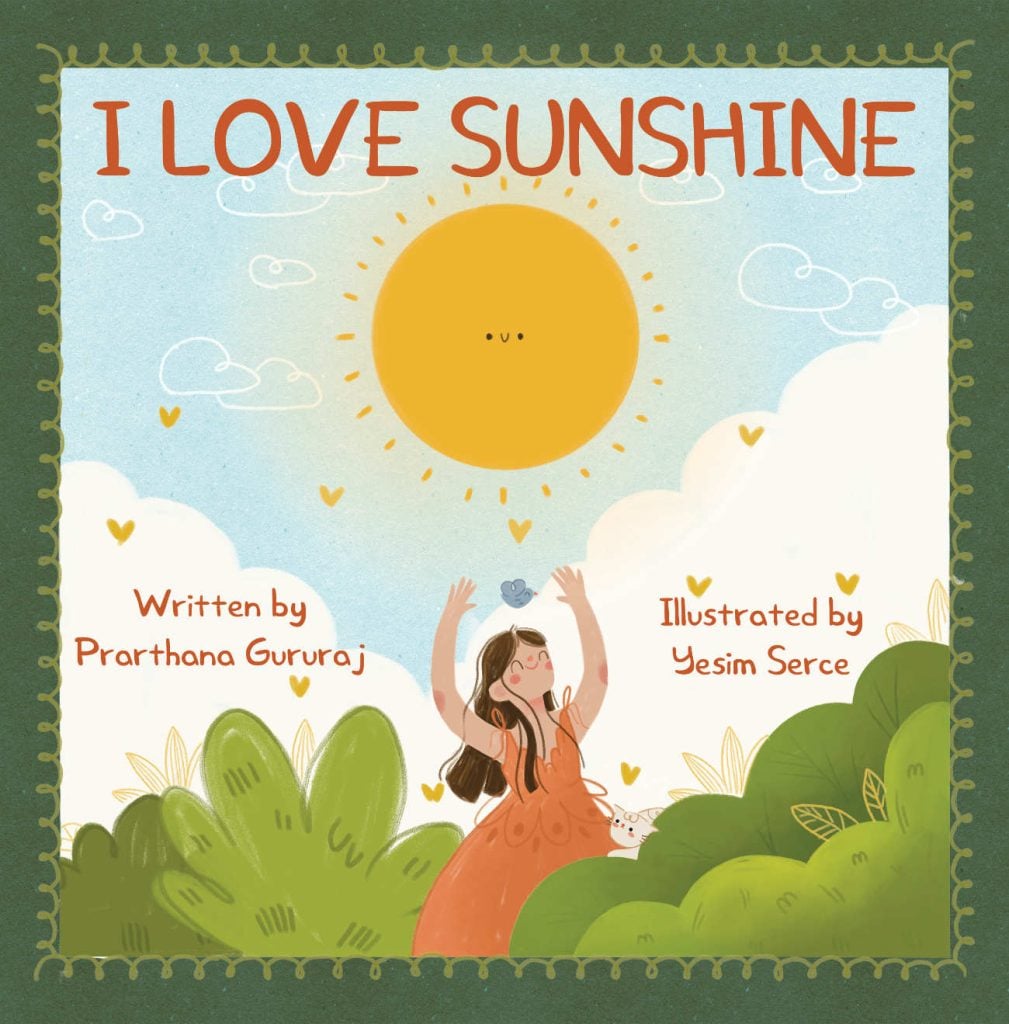
I Love Sunshine
A little girl loves the sunshine: it makes the world warm and bright, with squirrels, bees, butterflies and marching ants to discover. She swings, slides and runs with friends, then settles on her picnic mat before playing again. This cheerful illustrated rhyming poem invites young readers to enjoy nature and outdoor fun.
Watch
Follow the animated read-along with pictures, words and narration.
Listen
Enjoy the audiobook and let the narration spark imagination.
Read
Read the illustrated poem at your own pace.


Read I Love Sunshine as text
I love sunshine because…
It makes my day
warm and bright…
I can play
until the night!
I can hide
behind the trees.
Chase the squirrels,
watch the bees!
Look!
My sparrow in the sky…
I love that
pretty butterfly!
“Let’s play catch,
just for fun!”
said the flowers
to the sun.
Up and down,
over my plants,
march the busy,
busy ants.
Flowers so big,
flowers so bright…
Red and yellow,
pink and white.
In my swing
I glide up high…
Oh! My feet
can touch the sky!
Up the slide,
my friends and I…
Whee! I come down,
hands up high!
I can jump,
play and run
With my friends
in the sun.
I wear my silly,
colourful hat
And sit upon
my picnic mat.
Time to eat
and watch the plane…
Then get up
and play again!
Buy the Paperback
Enjoy a screen-free book to share and reread.
PS: Your support means the world to us! When you make a purchase through an Amazon link, we may earn a small commission at no additional cost to you. This helps us spread the magic of free stories to children across the globe. Thank you for being a part of the Storyberries family!
Explore the poem
Meaning of the Poem “I Love Sunshine”
Explore the poem’s ideas, events and lasting impression.
“I Love Sunshine” is an illustrated children’s poem by Prarthana Gururaj. An enthusiastic young speaker describes what makes a sunny day enjoyable, from watching small creatures to playing outside. Short lines, lively exclamations and gently connected scenes give the poem the feel of a child sharing favourite moments as they happen.
Rather than presenting a problem to solve, the poem celebrates noticing and enjoying familiar surroundings. Sunshine makes the day feel “warm and bright”, while birds, insects and flowers turn an ordinary garden into a place of discovery. The child’s delight in playing with friends suggests that simple experiences can be satisfying when they are shared.
The speaker first imagines the many things she can do in the sunshine: hiding among trees, watching bees, spotting a sparrow and admiring a butterfly. Flowers playfully address the sun, and ants move among plants. The child then notices brightly coloured flowers, swings high, slides, jumps and runs with friends before putting on a colourful hat and sitting down for a picnic.
The final lines show the child eating, watching a plane and getting up to play again. This return to activity gives the poem a circular, buoyant ending: a sunny day still has more pleasures to offer. Its mood is cheerful and observant, making it suited to shared reading or conversation about children’s own outdoor experiences.
Vocabulary
Discover useful new words and what they mean.
- Sparrow
- A small bird that the child spots in the sky.
- Glide
- To move smoothly, like the child swinging high.
- March
- To walk in a steady, purposeful way, like the busy ants.
- Colourful
- Full of different colours, like the child’s silly hat.
- Picnic Mat
- A cloth or mat spread on the ground for sitting outdoors.
Language Features
Explore how sounds, images and language choices shape the poem.
End rhyme and soundThe poem often pairs similar ending sounds across neighbouring thoughts: “bright” and “night”, “trees” and “bees”, and “hat” and “mat”. These clear rhymes make short passages satisfying to hear and easy to anticipate. The pattern is playful rather than perfectly regular throughout, so a read-aloud can follow the natural sense of each line without forcing a strict beat.
PersonificationThe flowers speak when they invite the sun to play catch. Giving flowers the ability to talk turns the garden into an imaginary playmate and joins the natural world to the child’s games. The effect is light-hearted, encouraging children to picture conversations between things that cannot really speak.
Repetition and energetic verbsThe doubled word “busy, busy” draws attention to the ants’ movement. Verbs such as “hide”, “Chase”, “glide”, “jump” and “run” keep the voice active, while repeated first-person statements make the speaker’s excitement feel immediate. Try speaking these lines with different rhythms or matching an action to each verb.
Colour and playful exaggerationDescriptions such as “warm and bright” and “Red and yellow, pink and white” provide concrete images for children to picture. When the child exclaims “My feet / can touch the sky!”, the impossible height expresses how thrilling a swing feels. The colourful images and exaggeration make familiar outdoor play seem especially vivid.
Discussion questions
Use the poem to spark thoughtful, imaginative conversations.
Happiness
- Which sunny-day moment seems the most joyful to you, and what makes it special?
- How would you describe the feeling of moving high on a swing?
- What small thing outdoors has made you smile recently?
Friendship
- What games do you enjoy playing with friends outside?
- The child runs with friends and goes up the slide. How could everyone get a turn?
- What would you say to invite someone new to play with you?
Curiosity
- Why might the ants be marching up and down the plants?
- What would you ask the sparrow or butterfly if it could answer?
- The flowers talk to the sun. What might the sun say back?
Seasons
- What colours and creatures in the poem remind you of sunny weather?
- How might the same garden look or feel on a rainy or chilly day?
- What would you choose to do outside in your favourite season?
Frequently Asked Questions
Helpful answers for parents and teachers.
Who is speaking in “I Love Sunshine”?
The speaker is an unnamed child who describes what she enjoys about a sunny day. The illustrations show a young girl exploring the outdoors, playing on swings and slides, and spending time with friends. Using “I” makes the poem easy for children to join in, imagining the experiences as their own.
What does “My feet can touch the sky!” mean?
The child is describing how high she feels when swinging. Her feet do not literally reach the sky; the playful exaggeration captures the excitement of moving through the air. Invite your child to describe how a swing feels, using their own imaginative words.
Why do the flowers speak to the sun?
The flowers pretend to talk when they invite the sun to play catch. This imaginative moment makes the garden feel lively and friendly. Children can think of something another flower, cloud or tree might say, then act out the conversation.
How can I read this poem aloud with my child?
Read at a relaxed, lively pace, pausing at the ends of lines so the sounds can be heard. Let your child join in with “busy, busy ants” or the exclamation “Whee!” The illustrated pages also help children follow the words. Explore more rhyming poems for kids for similar shared reading.
What nature details can children find in the poem?
The child notices squirrels, bees, a sparrow, a butterfly, ants, flowers and trees. After reading, look together for creatures and plants in a garden or park, or find them in the illustrations. Talk about what each creature is doing rather than assuming that every animal appears on every outing.
How could teachers use the poem for an early-years activity?
Use the words “Red and yellow, pink and white” for a colour hunt, or invite children to make simple movements for “jump”, “run”, “glide” and “march”. A picture-and-word matching activity can also connect the poem to observations of seasons and changing weather.
Can this cheerful daytime poem be part of a bedtime routine?
Yes. Although the poem celebrates energetic outdoor play, adults can read it gently at bedtime and ask children to remember one enjoyable moment from the day. The closing return to play is upbeat rather than sleepy, so it may suit an early part of a quiet evening routine rather than the final settling-down moment.
Credits
Meet the people who brought I Love Sunshine to life.
Written by: Prarthana Gururaj
Illustrated by: Yesim Serce
Edited and narrated by: Jade Maitre
Video music: “Blue Ska” by Kevin MacLeod (incompetech.com), licensed under Creative Commons Attribution 4.0.

Copyright © Storyberries